Sunday, July 31, 2011
Minnesota's Bike Sharing Growing to 1,200 Bikes
I have been really impressed with the progress up in Minnesota over the past year or so. In the land of cold winters, topography, and varying political winds, they are pushing the boundaries of cycling. Nice Ride MN, Minnesota's great bike sharing program, is growing up fast. There are already a good number of bike stations (as you can see on this map), but they are expanding: They started last year with 65 stations and 700 bikes, and this year they're planning to end up with around 115 stations and 1,200 bikes. Reception has been good so far, and only one bike has been stolen (not bad compared to other public bike sharing programs). Check out the video above for more details on how it works and how - if you ever are in the area - you can rent a bike.


Friday, July 29, 2011
Cycling Up 14% In NYC

And it comes on the same day that a Quinnipiac University poll shows support for bike lanes edging up from a 17 point margin to a 24 percent margin, or from 56 to 39 percent in May to 59 to 35 percent today. In March, the margin of support was 54 to 39 percent.
Most of the increase in support comes in Brooklyn, home to a controversial lawsuit to remove a two-way protected bike lane next to Prospect Park. In May, 56 percent of Brooklynites said bike lanes “were a good thing because it’s greener and healthier for people to ride their bicycle,” and 39 percent said bike lane are “a bad thing because [they] leave less room for cars which increases traffic. Now, according to Quinnipiac, that margin is 26 percent — or 60 to 34 percent.
Bike lanes are the least popular in Staten Island, the only one of New York City’s five boroughs where fewer people like bike lanes than like them, 38 to 53 percent.

New York City says cycling is up by 262 percent since 2000, while, it says, the average risk of serious injury to cyclists declined 72 percent from 2000 to 2010. But the data shows an uptick in serious injuries between 2009 and 2010, from 100 to 113. In the last decade, the city has added nearly 400 miles of bike lanes.
Other big city mayors, including Mayor Antonio Villaraigosa of Los Angeles and Chicago Mayor Rahm Emanuel, have said they want to expand their bike networks — by 40 miles a year in L.A. and 125 miles in Chicago by the end of Emanuel’s first term in office.
New York City counts cycling differently from other cities, which tend to rely on American Community Survey, or census data. But that data only counts commuters who use say in a survey they cycle as their primary way of getting to work, not actual numbers of cyclists on the streets.
New York City began counting cyclists at six heavily biked locations in 1985, when 3,440 cyclists per day were recorded. The locations are: the Manhattan sides of the Brooklyn Bridge, Ed Koch Queensboro Bridge, Manhattan Bridge and the Williamsburg Bridge; at the Whitehall Ferry Terminal and on the Hudson River Greenway at 50th Street.
Thursday, July 28, 2011
Orlando's First Bike Corral


The new corral was installed in front of Ethos Vegan Kitchen, and even though a new bike rack isn't usually news worthy, this type of bike parking could be a break through for the increasing bike problems (lack there of) that face cities. This bike coral takes away one parking space for a car and installs 6 bike rings that could easily hold 12 bikes.
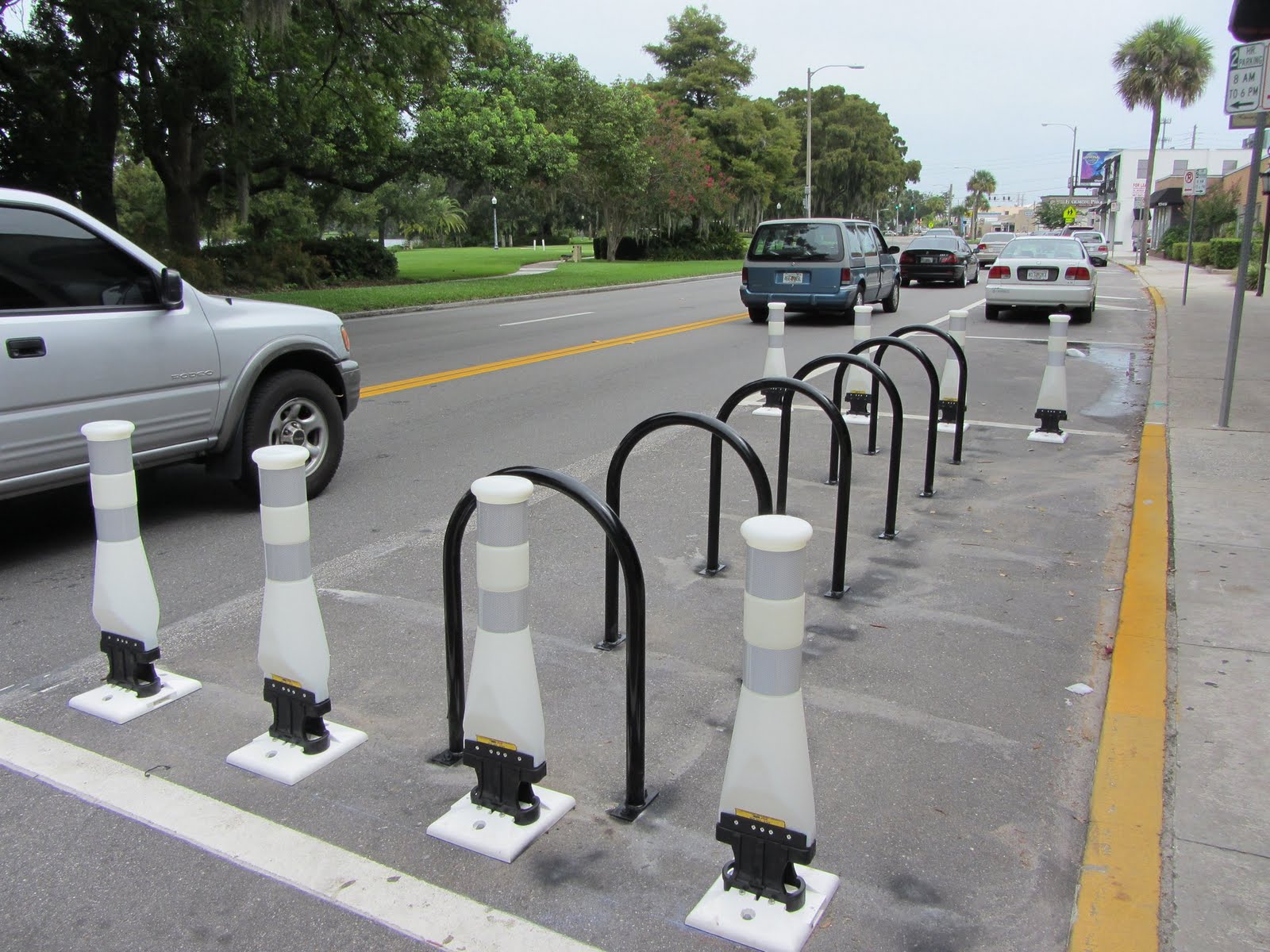 Providing ample, convenient, comfortable and secure bicycle parking is an important part of serving those who currently use bicycles for transportation and encouraging future cyclists. Bicycle parking is an inexpensive and efficient means of increasing both public and private parking capacity for the city as a whole.
Wednesday, July 27, 2011
Since my visit to the Be Spoke exhibit at the Museum of Art and Design in NYC last summer, I have been interested in custom bicycle design. Of course there are plenty of fancy futuristic bicycle designs, but I always like to know what the future will bring in terms of cooler features and entirely novel forms. You'll notice, that most of the future-oriented bicycle ideas sport a bit of a Jetson's feel while falling short on amenities city cyclists really need - kickstands, fenders, back racks. Oregon Manifest, a bike design challenged sponsored in part by Levi's (recently out with bicycle jeans), is aiming to find the future of utility bikes. Competing for a $3,000 prize, craftspeople and student teams are looking to innovate, show off their bike builder chops, and fashion a bike that makes people able and willing to get out of their cars. Take a look!
"The economy is forcing everyone to focus on cycling as transportation, but too often "city bikes" are just road bikes with fenders and racks slapped on. Everyone's staying in the same box as far as design and approach. But Oregon Manifest is pushing us to find a better answer." - Shane Fedon - De Novo
 A lineup of 34 illustrious bike builders and many student designers from Oregon as well as other U.S. states are working with some fairly specific smart criteria for a city bike. The bikes must have built-in anti-theft devices, fenders, lighting, some load-carrying capability, and some sort of kickstand mechanism so the bike can stand while parked.
Manifest's panel of judges will be looking for entries that also push the envelope in terms of function, materials used, technologies employed, and the ability of the bike to adapt to different environments and lifestyles.
And of course, it has to look good - "a complete harmonious aesthetic and functional whole," as the criteria states, with thought to a modern cycling audience and "curb appeal."
Not only that, right before awards are given, the bicycle design entries will be put through the paces - at least 50 miles of terrains including urban scenes, dirt roads, asphalt, gravel, hills, and stairs. I'll follow the action with posts on how the future of city and utility biking is truly shaping up. Stay tuned.
Monday, July 25, 2011
This past weekend I had some good friends come up from South Florida and do some road riding in the hills of Clermont Florida. We also got to enjoy the final weekend of the Tour de France and some good conversations about the progress in Miami with their bike infrastructure. Apparently lots of new sharrows have been painted throughout the City of Miami and a new bike lane has been installed in Miami Beach.
It is great to see that the City is adding infrastructure to help the new DecoBike sharing program have safe routes for its users. It is also great to see that progress is coming to the Sunshine State and that riding a bike is no longer taboo, but is being embraced by all.


It is great to see that the City is adding infrastructure to help the new DecoBike sharing program have safe routes for its users. It is also great to see that progress is coming to the Sunshine State and that riding a bike is no longer taboo, but is being embraced by all.

NW 10th Ave, between NW 7th St and SW 8th St (Little Havana)

NW 46th St, between 17th Ave and N.Miami Ave (Liberty City / Buena Vista)

NE 14th St, between NE 1st Ct and N. Bayshore Dr (Omni)

NW 28th St, between 17th Ave and 7th Ave (Allapattah)

Indian Creek Dr, between 41st St and 27th St (Miami Beach)
Thursday, July 21, 2011
New Bike Bus Concept Looks Promissing
BIKE GUIDE from Kukil Han on Vimeo.
A designer named Kukil Han from Seoul has posted his well thought-out innovation for a linked vehicle system he calls Bike Guide that would allow people to travel to tourists destinations around the South Korean capital in an eco-friendly manner. Han's concept is one of the best I've seen recently, and has a great deal of potential for European and American cities as well.
The idea is that people can sign-up for a guided tour of Seoul at any of the kiosks installed around the city. At the stations, tourists can see stops along the route, check for the next pick-up time, and pre-pay for the service using a touch-screen display. A hybrid bike-bus equipped with a solar power roof, seen in the image below, takes passengers to central spots around the region, where the bikes then detach for individuals to explore on their own before returning to bus and on to the next location.
Inside the bike-corral, riders can watch a television for information about the next point of interest, and, when exploring on the bike, have access to the same information, including departure time, GPS navigation, historical facts and more, on a handlebar mounted display.
From the video Han has posted, it seem the bikes are of the regular variety, however, I'd like to suggest electric bicycles instead, which would give riders more range. Plus, since the bikes are already mounted with a display unit, a lithium-ion battery system could help power the device, and the once mounted back on the bus, be recharged through its system, or through pedal-assist technology.
Tuesday, July 19, 2011
Update on Chicago's Protected Bike Lanes

In early June I shared the good news of Chicago's progressive plan for protected bike lanes and cycle tracks under their new mayor, Rahm Emanuel. Unlike some cities, they are keeping their promises about bike lanes and Rahm Emanuel and Gabe Klein are now planning over100 miles of protected bike lanes to Chicago.
Funded by a federal grant, the Chicago Department of Transportation is installing the half-mile bike lane as a pilot program. The protected bike lanes will have a three feet buffer to parked cars and will be separated by delineated posts.
Previous to his Chicago position, Klein served as the director of The District Department of Transportation in Washington, DC, where during his tenure, the city launched a bike-share program and expanded bike lanes.
I'm looking forward to watching and supporting Chicago’s efforts in increasing sustainable transportation options. Watch the video below to learn more about Chicago’s bike lane expansions.
Subscribe to:
Posts (Atom)


 Posts
Posts


