Tuesday morning, Marty Katz, a regular rider in the “third group” at Lakemont was on his way to meet a morning group in Maitland. Stopped at a red light, in the left turn lane, on Horatio Avenue, he was hit by a car. His injuries are extensive and he’s in ICU at Orlando Regional Medical Center. He sustained 8 or 9 broken ribs, a fractured femur, hip, pelvis and clavicle. The vehicle was being driven by a high school who had several girls with her in the car heading to school.
Marty underwent surgery on Wednesday, but is breathing now only with the aid of a ventilator. He is listed in critical condition and the family has requested that there be no visitors but earnestly seeks prayers. A brief prayer vigil was held Thursday night at Lakemont Elementary and before we headed out this morning we had a brief moment of silence and talked about safety issues. Even though Marty had lights on his bike, we were reminded how important visibility is for a cyclist on the road. Being made fun of for looking like a Christmas tree or ambulance may not be a bad thing considering the alternative.
Today was also a reminder of the Ride 2 Recovery ride that is happening tomorrow morning. When I rolled up this morning there were 2 veterans in their Ride 2 Recovery kits on and seeing them out on bikes was a great inspiration. One of the soldiers was missing a left arm and leg and was riding with prosthetic limbs. Nothing can inspire you more than seeing someone that has sacrificed for our country andthen is out riding with the heart of a champion. Absolutely amazing.
You too can honor America’s recovering veterans with a bicycle ride through Seminole County tomorrow, October 17. Ride 2 Recovery of Florida is an advocacy group that promotes cycling as a vehicle to assist in the recovery and rehabilitation of wounded military veterans. The “Seminole Cyclefest” is a ride designed to raise the awareness of the physical and psychological rehabilitative values of cycling among the civilian, military, and wounded warrior communities. All monies raised by this event will be used to assist in the recovery of injured veterans. For more information about Ride 2 Recovery of Florida refer to: www.ride2recoveryflorida.com.
Join this group of cycling advocates as they casually ride through Seminole County with the escort of the Seminole County Sheriff. The ride is open to the public by registration at www.Active.com. “Seminole Cyclefest”. The “Seminole Cyclefest” will start and finish at David’s World Cycles, 1201 South International Parkway, Lake Mary, Florida. The ride will start promptly at 8:30 AM on Sunday, October 17, 2010. Riders will select either a 24 mile or 58 mile course through the picturesque townships and lakes of Seminole County. The ride will be completely supported with rest stations placed approximately 15 miles apart. All participants receive the official Ride 2 Recovery tee shirt. Ride packets can be picked up at David’s World Cycle starting at 7:00 AM on the day of the ride. Same day registration will also begin at 7:00 AM on October 17 at David’s World Cycles.
I think you know it is going to be a good day when you get to the corner of Central Park and see a sign that says "Caution Bicycle Race In Progress". I started having flash backs to riding with the Lakemont group, the Horrible 100, etc. The cool thing about this race was that it was almost like watching a professional race. They had motor bikes to lead the race and race officials with referee whistles and orange cones and flags to mark road obstacles.
The Central Park circuit is 6.25 miles and their race was comprised of 10 laps. This gave them a pretty good variety of hills and wide open road to speed through. The race organizers weren't able to close the park, so it was full of spectators and fans that cheered on the riders as they sped by. I watched a few laps and had to head back to the apartment, but I am researching some of their bike clubs to see when their next rides are.
I am going to try to not just write about the Tour de France for the next month, but it will be taking up most of my time. I love watching road races and Versus Channel has really helped the ease of viewing. I will still be watching live each morning on Steephill.tv, but their recap shows each night make it pretty nice to see what I may miss when I have to do some work away from my computer.
Below is a pretty cool video that shows the stages in a 3D fly through. I am also listing my 12 riders to watch in this year's Tour. They are listed alphabetically:
Lance Armstrong
Alberto Contador
Cadel Evans
Robert Gesink
Levi Leipheimer
Denis Menchov
Michael Rogers
Samuel Sanchez
Andy Schleck
Frank Schleck
Christian Vande Velde
Bradley Wiggins
Alberto Contador is the man to beat for a second straight year, any one of these 12 could win the Tour de France this year. I will go further and say that the top three in Paris all figure among these 12 names. The Tour rarely produces a surprise result. These are the men who will worry excessively about the first few days of the race as far as Reims, where crosswinds in Holland and bad roads in Belgium will make it a nervous period for those with big intentions.
Do not miss the early days thinking everything will happen in the mountains. People like Contador, Michael Rogers and Bradley Wiggins will be happier when the Alps are reached and that they are still in contention, for some of the above names will not be after this very dangerous opening week. With only one time trial this year (with the exception of the usual short Prologue in Rotterdam, Holland) the route appears to favor the climbers.
This is not surprising, as the race celebrates 100 years of scaling the heights of France. The Pyrenees with the Col du Tourmalet the star of a tough last period of racing with a finish and a crossing included on the mountain, came into the race in 1910 to the cries of "assassins" and "murderers" from the riders. But without France's two famous mountain chains, the race would have died many years ago.
Lance Armstrong, in his 39th year, would not be starting his 13th Tour if he did not believe he could win it. He arrives with his new custom-assembled RadioShack team many of whom rode with him in 2009 as members of the often acrimonious Astana team, for whom Contador still races. If the great Texan who has suffered sickness and crashes this year before finishing second in the recent Tour of Switzerland, is to win for an eighth time, then he must get time on Contador before the mountains are encountered.
Contador, is the undisputed best climber in the World, but has not showed the great form necessary to win a third Tour de France and with the Schleck brothers, Australian Cadel Evans and perhaps Bradley Wiggins, all out to attack him when he's least expecting it, the Spaniard will assuredly have his hands full. Contador beat Andy Schleck by 4mins 11sec last year, with Armstrong far from content with third place a further 1min 13sec back. This year Andy has done nothing to inspire confidence in his fitness and it could be that his elder brother Frank, the winner of the Tour of Switzerland, will be the protected rider on the Saxo Bank team.
The first mountain stage comes after a week of racing in which 700 miles will have been covered, with a previously uncharted journey through the Jura hills to the Station des Rousses. The weather there can be very cold and wet and is followed the next day by the Alps proper as the field finishes atop the ski station of Avoriaz, near Morzine, where it has not been for 16 years. It was in the Juras where Armstrong abandoned the race in 1996 complaining of a heavy cold, and was later in the year diagnosed with cancer.
Once the Alps are over, it is through the heat of the far South as the link is made to the Pyrenees, where a finish on top of the Col du Tourmalet will be the highlight of four very hard days that will favor the great climbers. The only time trial follows for those with the strength left, near Bordeaux, where the heat can sap whatever power is left in the bronzed legs of the survivors. Levi Leipheimer could well show his strength here as he has done in the past. In 2007 he finished third overall after he won the final time trial over a similar distance in Angouleme, beating Evans by 51secs. He lost the Tour by a meager 31secs the next day in Paris.
American supporters will also be cheering the sprinters on the days they have a chance of victory. Tyler Farrar has developed into one of the fastest on the pro circuit and with five wins already this year, the Garmin-Transistions rider will be ready to win his first Tour stages. I am also looking forward to see Mark Cavendish win the green jersey and show the world why he is the best sprinter in the world.
There's an idea floating around of Swiss rider Fabian Cancellara using an electric motor at the classics. It seems to have originated at the rumor mills of il Italia and a couple of journalists, an ex-pro cyclist and a little known e-bike maker are in the thick of it. Meanwhile, Fabian tossed out a statement in the press calling hogwash to these claims. I am only writing about this topic this late, because I haven't felt that it was a legitimate issue, but after talking to several other riders and hearing them state that they believed the accusations, I felt that I had to do some online investigating. Here is what I have found out...
Below is a detailed explanation of how Cancellara was physically able to ride the way he did in the accused rides. This study was done by Cozy Beehive's blog.
I spent some time re-watching 2010 Paris Roubaix clips. My focus was upon the attack from Cancellara with 48k to go. To me, there were three segments to this attack
1) At 55K remaining, there were a lead group of 40 favorites at the front.They included Tom Boonen (Quick Step), Fabian Cancellara (Saxo Bank), Filippo Pozzato (Katusha), Adam Hansen (HTC-Columbia), George Hincapie (BMC Racing Team), Leif Hoste (Omega Pharma-Lotto) etc.
2) In the next 2 or 3K, the group splintered. Leif Hoste, Björn Leukemans, Frederic Guesdon and Sébastien Hinault pushed to the front.
3) At 49 K to go, Fabian Cancellara surged ahead from the bunch to join the four leaders. In a few seconds, he took one sideways look behind him, saw that the title defender Boonen had decided not to mark him down. Riis, the team manager, radioed to him. "Go". Yup, it was a bad move from the Belgian champion. Fabian was then gone and the rest is history.
The jump Fabian put forth was strong and decisive. To most of us, watching the surge (see video below) may seem almost like, well, like he had a motor somewhere on the bike. How on earth can he pull away so quick, right? Well the Italians asked that hard question and came up with the answer - 'Oh mio dio, he has a motor on his bike!'
But regardless of whether he used a motor or not, can we dissect this attack and see its parts to get a perspective of what's happening? I think we could.
So I used a physics analysis software and some basic physics to get an idea of the speed and acceleration involved in this attack. This may seem pretty ghetto to some of you but perspective is what ultimately matters.
STEPS
1) First, I downloaded the above video of the action from Youtube. I cut the video segment only to the points of interest, from 2:07 to 2:22 or so. I eventually a few hundred frames at 25 frames/second. I decided a timestep of about 0.03-0.04 seconds would be more than adequate to the capture the stages of the action.
2) I scaled the segment with a known dimension of some entity. That entity was going to be Cancellara's 58cm Specialized bike. I looked up its specs and found out that the wheelbase of the frame is pretty close to 100 cm or 1m. Good enough.
3) I imagined myself seated inside the TV helicopter, shining a path co-ordinate axis down at the action below, somewhere in the middle of the screen. I reckoned that the zoom and pan from the helicopter camera would create complexities, but luckily for me, there was not much. The cameraman in the helicopter had kept his focus remarkably steady on the racers, without much shaking and distraction. There was a bit, but I knew exactly where it was. Then I positioned the axis angle to be somewhat parallel to the direction of motion on the road.
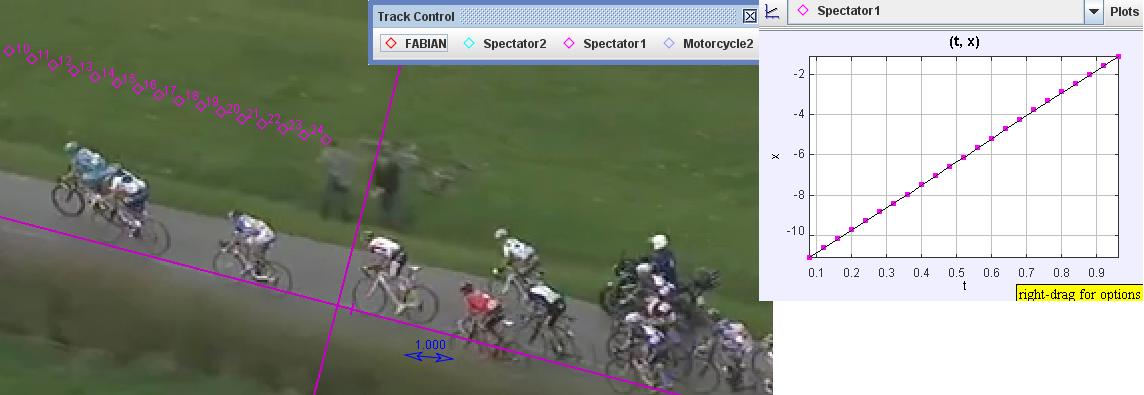
4)I then stuck point mass trackers on Fabian, spectators and motorcycles. These trackers would give me position vs time information of the object as the cross-hairs of the camera sped past them.
I finally had distance vs time plots from objects to plug into MS Excel. Since velocity depends on the observer, and since the observer is in a moving state in a helicopter, any relative motion between the observer and the cyclists is either a surge or a deceleration.
Let's explore the stages of the attack:
A) At what speed was the peloton with favorites moving initially?
Here, helicopter camera was very focused on the action with little shaking. Hence, a spectator appearing and flying out of view may give an indication of the speed of the riders. The position time graph was a straight line. The data was exported in Excel and a "linest" operation on the data yielded a slope, as shown below.
25 mph is not hard to believe.
B) What was the speed of the lead group that surged away?
Here's another spectator! Let's catch him!! So we place a tracker on his bosom.
This is how fast he flies away from the camera. The slope tells me 29mph. Hence, the leaders broke off with an extra 4 mph relative to the peloton.
C) The attack : How fast can Fabian put a 5 second gap on others?
This pic shows a tracker placed on Fabian, and the graph shows his position changing wrt to the origin due to relative motion. This relative motion is the attack!
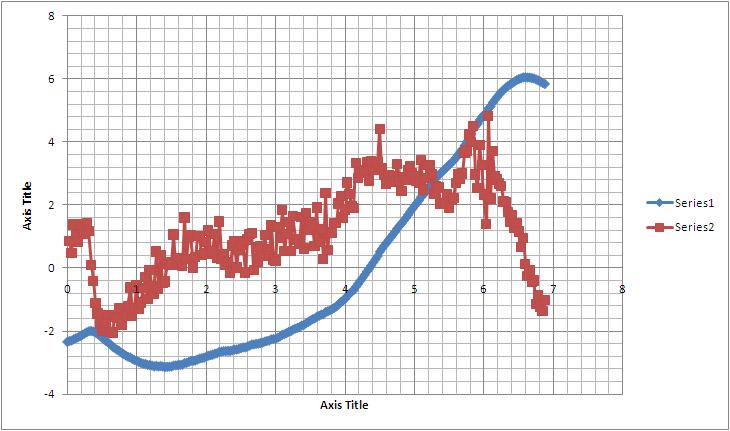
Fabian was to the right of camera's origin (purple axis) before he attacked. The camera was focused on the lead group and did not follow Cancellara when he attacked due to the "lag" in reaction time from the cameraman. The downward slope on this graph indicates Cancellara moving towards the negative left side of the origin with his surge. In a little over 4 seconds, the brunt of the attack came, when the slope of the graph dips further, indicating acceleration. The area of interest is limited to 12 seconds because the cameraman suddenly finds out what's happening and shifts his focus to Fabian. This is why the red line begins to curve back up again.
So I exported that graph into Excel, inverted the graph so I would get nice positive numbers. Then I cut the graph to the area of interest.
Presto! This shows us that Fabian puts in a 5" gap very quickly. But how quick is "quickly"?
...this gives us an idea of Fabian's relative speed from the camera focus. So what happens in this 5" gap that Fabian puts relative to peloton? In the first 2 seconds, he manages +1.6 mph. In the next half second or so, he increases that to +3.3 mph, which then bumps up to +6.5 mph until at the second before the camera catches up with Fabian, he's riding at an impressive +7.4mph.
Since I wrote before that camera's focus was traveling at 29mph, this means that the Fabian's respective speeds are 30.6 mph (49.2kph), 32.3 mph (52.3kph), 35.5 mph (57kph) and finally 36.4 mph (58.5kph). This corresponds to an acceleration of around 0.7-0.9 m/sec^2. Ordinary cars have an acceleration of 3-4 m/sec^2. Fabian musters close to 25% of a car's acceleration. Vroom!
D) A reality check :
I stuck a tracker on a passing motorcycle as it sped past Cancellara to "get out of the way". Perhaps it was Graham Watson in the back seat as the flashes of a camera went off. Nevertheless, I found it had a relative speed of +25mph from similar analysis. Adding this to Cancellara's speed of 29mph gives a roundabout motorcycle speed of 60mph (96kph). Its believable.
Also, if I were to plug in the speed I obtained and Cancellara's weight and cadence into Analytic Cycling's "Forces on Rider" calculator (with generic parameters), it gives me about 680 Watts of power. Still believable by STATIC riding standards.
But since I said that he's accelerating with 0.9m/s, given a weight total weight of 87kg (80 kg Fabian and 7 kg bike) and a final speed of 16m/s, we should really calculate his power output and crank torque in a dynamic situation. For the crucial 5 seconds of attack time, I calculate all those below.
I assume Fabian was on his 53-11 gear, which I'm sure he could easily pedal.
Onto the propulsive force required.
Work done then becomes :
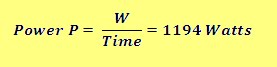
So what is his power output to accelerate for those first 5 seconds?
Though not very relevant, also notice that this power output equates to a rough 5 sec power to weight ratio of 1200W /80kg = 15 which is nothing out of the ordinary based on a power to weight ratio chart for male cyclists (See Power to Weight Ratio).
Using a stopwatch, I figured Cancellara increased his RPM from his previous 100 to 110 RPM for his attack. The average torque required for this acceleration at the crank is then :
That value is within the realm of competitive cycling. Since I said this is an average, it would be the average of the "sine-curve" of torque on the y-axis and crank angle on the x axis. The crank torque is scaled down at the rear wheel by a factor of the gear ratio, calculated earlier, since it rotates faster.
For readers on both side of the Atlantic Ocean, I put this all together in one table with units :
My sanity check is over. The numbers are believable by DYNAMIC riding standards. Any doubt? Note that some data from the recent Tour of Flanders indicates that he put in 1450 Watts during the attack on the Muur. That number came after a very long day of riding. If he can manage that, he can surely manage 1200 Watts in the initial moments of his breakaway.
This is my two cents.
CONCLUSION
It is the first 5-10 seconds of an attack that is most crucial and most tricky. Attackers must be able to speed off from an already high pace, and the objective is to dig in to hell, gather the firepower and deliver the maximum blow without suicide.
It is the rapid rate at which Fabian Cancellara increases his speed that is mind boggling to see in the video, even though such speeds are pretty normal for him.
Don't get hung up on the numbers presented here, which is all approximate. But we know from historical data that Fabian is someone who can out-sprint the best by simply staying seated on his saddle, even after 230K of racing. The following is one of those spectacular moments of Tour de France history that will not erode away with time. Watch:
It is May 16th and another beautiful day in Florida. I rode the Lakemont Ride yesterday, which has added a 4th group to it, so there are even more riders coming out. The D Group is being led by Billy Hattaway, a past co-worker with me and a really good guy. The ride is 40 miles with a stop halfway and a pace that is a consistent 18-20mph, with no drops. I encourage any of my rider friends that may have been intimidated by the other groups, because of their speed and intensity, to try out this ride and get into the Lakemont experience.
The other great parts of it being May 16, is the Giro d'Italia is on stage 8, the Tour of California starts this afternoon, and Bike Month is halfway finished. The Giro d'Italia is always a tricky race and this year has been no different. Several of the big name riders (Armstrong and the Radioshack team, Mark Cavendish (HTC-Columbia), Andy Schleck and Fabian Cancellara (Saxo Bank), Tom Danielson (Garmin-Transitions), Tom Boonen (Quick Step), and Lars Boom (Rabobank), Heinrich Haussler (Cervelo Test Team) and US Champion George Hincapie (BMC Racing)) are not there because they are riding in the Tour of California this week. The World Champion from Australia, Cadel Evans (BMC), is currently leading in the Giro and the race has been full of crashes, beautiful Italian scenery, and typical race antics. The Tour of California is a good primer for the Tour de France and many riders are choosing to ride it instead of the Giro, because it isn't as long and taxing and they can go all out for just 8 stages and make adjustments for the Tour de France.
Tomorrow stats the official Bike Week, so I am hoping for many new cyclists out on the road. Coordinate riding to work with friends and co-workers and try to ride on days other than your city's Bike to Work Day. Give commuting by bike a chance for a week and I promise that you will see how easy it can be and you might get hooked.
A few weeks ago I wrote a post that described the huge benefits of eating properly during a long ride. Many cyclists consider sports bars and gels to be handy pre-ride snacks and a good source of calories during rides. These energy sources help provide ample carbohydrates, with minimal amounts of fat and protein.
When cyclists forgo meals or don't eat the right things, their blood glucose drops and you're more likely to get the "bonk" on a ride. Eating a high-carbohydrate sports bar an hour or so before cycling will help to maintain your blood glucose levels so that you can perform optimally.
Researchers at Ohio State University found that performance was improved by 12.5 percent when carbohydrate was consumed an hour before exercise. They advised to consume 40 to 75 grams of carbohydrate in the hour before your workout. The energy boost you get from eating a sports bar or gel before or during exercise comes primarily from the carbohydrate in the bars (about 25 to 47 grams) and gels (about 20 grams to 25 grams), which elevates your blood glucose to provide energy to your cycling muscles.
There's nothing special about the carbohydrate that sports bars and gels supply. You can get the same results from traditional high-carbohydrate snacks such as Fig Newtons, bananas, low-fat granola bars or breakfast bars are also good, less expensive alternatives to sports bars or gels. Sports bars and gels also are an accessible energy source during your time on the bike. Consuming carbohydrate during rides lasting an hour or longer enables you to ride longer and harder by providing glucose for your muscles when they begin to run out of glycogen (glycogen is stored carbohydrate in the muscle).
Filling Up
High-carbohydrate foods such as sports bars, Fig Newtons, and bananas provide a feeling of "fullness" that you won't get from drinking fluids or sucking down gels. Sports bars and gels purposely have a very low water content so that they can be compact and easily carried. Concentrated carbs are definitely the way to go.
To get the amount of carbohydrate supplied by one Clif Bar (40 to 45 grams), you'd have to eat 1.5 bananas (45 grams). One gel packet supplies only slightly less carbohydrate (25 grams) than one banana (25 to 30 grams).
The low water content of sports bars and gels also has a disadvantage. You should consume about 6 to 8 ounces of water when you eat a sports bar or carbohydrate gel before or during exercise. Otherwise the product will settle poorly and you may feel nauseated because of the slow digestion. In addition to aiding your digestion, drinking water after consuming the bar or gel encourages you to hydrate adequately.
The bottom line on sports bars and gels is that they're a convenient way to help meet your carbohydrate requirements before and during cycling.
Below is a recipe that I found online of a "homemade goop".
Homebrew Power Goop
7 and 1/3 tablespoons of honey
3/4 teaspoons of blackstrap molasses
1/10 teaspoons (just shy of 1/8 tsp) of table salt
Be sure to mix everything together well. It should make enough to fill a five-serving GU flask.
The honey in the recipe provides a bunch of good carbohydrates and vitamins. Honey alone is nutritionally very close to power goop, but it lacks a bit of sodium and potassium. Molasses has a ton of potassium, and if you can find blackstrap molasses, it has even more! As for the sodium, just add some salt.
Try these tips out and ride longer and ride farther! The main thing is to get out there and ride!!!
This weekend's weather has been too beautiful to be sitting inside updating the blog. The Saturday morning Lakemont Ride had about 200 riders overall, and at least 100 alone in the B ride that I participate in. I felt better than ever in the saddle and had plenty of juice to keep up with the pack.
I do have 2 lessons learned from Saturday. The first one is something that most people know, but I have just now become a believer in. The Lakemont Ride is only 2 hours, so I haven't been taking any food/energy supplements, but I have been feeling drained on the past few weeks when we picked up the pace and felt that a few extra calories couldn't hurt. I packed a small peanut butter sandwich and it hit the spot. I could only eat a bite at a time, but that helped ration it out throughout the whole ride. My advice: If you are riding over an hour, pack a small snack or energy supplement. This will give you the boost you need to get you down the road.
The second lesson came from a friend of mine, but I have personal experience in this too. My friend got some new SPD pedals and even though she clipped in and out a few times on Friday night, during her ride in Clermont, she fell 2 times. She didn't fall because of the clips being too tight or not functioning properly, but because she didn't realize which foot she instinctively put down on the ground first. I had this same experience with my toe in clipless pedals, but I just fell over and hurt my pride. She actually received some nasty road burn and a few bruises. She is good now, but I recommend clipping in and out along a fence or wall for practice, and the support if you can't get out of your pedals.
Days like today proves that all of the cold weather training pays off. I rode in the Lakemont B group this morning and with the temperatures reaching into the mid to upper 70s, the races were feeling it. We had a great group of about 70 riders and with no wind to deal with, the pack held together fairly well. It seemed that every time I glanced down at my cyclometer, we were churning at least 25+ mph and several times were topping 30 on flat stretches. Great day to be on the road!
Tomorrow morning out at UCF, the Orange County Council of PTAs are inviting everyone to participate in a world record bicycle parade. Registration begins at 9:30am and staging begins at 10:30. The route is 2.5 miles and should be a free, fun, event with a purpose!
The weather in Florida is in the 70s now, and is perfect riding conditions. Rode with the Lakemont group for the usual 50 miles of spandex clad fun.
We heard a grizzly story from last week's C group. With the temperatures starting out in the 50s when we get started, people are wearing base layers, arm warmers, etc. Apparently a guy was removing a jacket while riding at about 20mph and the wind caught it and sent it into his rear wheel. Needless to say it immediately wrapped into his spokes and chain and stopped the bike abruptly. This sent the rider head first over the bike and he struck his head hard enough that he was knocked out for a few seconds.
It was a good reminder that everyone needed to be careful when riding out there, and we needed to keep our eyes peeled for what the people around us may be trying to do. Just because people do it on the professional races, doesn't mean that we can do it too. Especially since that type of motion isn't something that we deal with on a ride to ride basis.
This morning's Lakemont ride was full of interesting drama. The weather was a cool 60 degrees and I think the group was trying to keep heart rates up to stay warm. I rode in the B group and we gave the A group our typical 5 minute head start, but we caught them by mile 8. That was when the speed and the fun really started.
The wind had been calm up to that point and maybe even a little bit to our tails, but that just meant that we were rolling at 25-30+mph and our hearts were beating out of our chests. This continued with both groups combined until about mile 20, and that's when things started to go awry. One of the local high schools was having a fundraiser 5K and we slowed slightly as we passed groups of runners, and I got distracted watching the crowds instead of focusing on the riders in front of me. Next thing I know the guy in front of me waves me up to pull and to my dismay, the main group was about 50 feet away from us. The rider apologized and just said "Sorry, I thought I could catch them back." I was full of anger and the sinking feeling of having to ride out of the main pack for the last 30 miles.
Luckily the group had been riding so fast that we had shed about half of the starting riders and they had grouped themselves into small packs of 5-10 riders. I decided that it was better to try to work together and finish, than attempt to catch the main group and blow myself up.
This turned out to be a great choice since around the next curve we hit a headwind of 15-20mph that crushed us for the remaining 30 miles. It wasn't a complete loss. I tried to look at it as an opportunity to get more training in, since I was required to do my portion of the pulling and didn't get the luxury of sitting back in the peloton and shield myself from the wind. It's days like today that I envy the smaller riders and I feel like my chest and shoulders are acting like a sail and pulling me back like I have a parachute around my waist.
Like I always say though, any day in the saddle is always better than the alternative, no matter the conditions. Ride on!
There is a wide range of different types of cyclists and many times these typologies overlap one another. Many names have been coined for different types of riders; hipster, commuter, spandex, parents and kids, etc. Within the past 24 hours I have gotten to ride with several of these..
Last night was the monthly Critical Mass ride in Orlando, and in over 300 cities around the world. Critical Mass is a group ride, which was over 200 riders last night, that rides at a slow to moderate pace through the main arterial streets of the city. The ride is intended to show bicycle awareness and to protest that bicycles are just as important as any other vehicle on the road.
It was pretty cool that I had a woman come up to me and ask me if I ride on Livingston every morning. I said yes, but that I hadn't remembered seeing her out there commuting in. She said that she was driving to work each day and that she drove a big van with dog paw prints painted on it. I actually recall that vehicle, since at 15mph you actually take in most of your surroundings and the dog paw prints are a pretty rare detail.
This morning I did my typical Saturday "Lakemont" ride. I cut through neighborhoods and ride 5 miles to get to the group start location, and the rising sun is the last peaceful moments for the next 2 hours. We had a good group of about 100 riders, ready to scorch the pavement.
The ride itself is 40 miles in 1.5 hours and there is no stopping or waiting for people to catch up. As we rode this morning I heard rumblings in the pack that a group of 6 or 7 were going to break off and attack at mile 30, and that is never good. When a breakaway occurs, the riders go off the front in a line and the pack responds and tries to catch them and pull them back in. It takes a ride that is a fast 25mph into a wild sprint that surpasses 30mph and splinters the pack.
Well the attackers kept their word at mile 30 and we finally caught them after riding at 32mph for about 2 miles. We finished the ride and ended with only about 30 riders (people get dropped and finish the ride alone or in small groups, or they end and head home early).
I love it because it sets up a great Saturday when you are home by 10am and feel like you already accomplished something and don't have to worry about doing anything but relaxing the rest of the day.








 Posts
Posts


