Showing posts with label Commuting. Show all posts

Wednesday, October 16, 2013

Bike Rush Hour in NYC

Bike Rush Hour NYC
Bike rush hour in NYC is still far from what it is in Amsterdam, Copenhagen, or Groningen, where torrents of cyclists seemingly take over the whole city. But the number of bike commuters certainly has been growing nicely in recent years.
This is what commuting should look like, at least in cities (I understand it's not practical everywhere, and that around half of the world population lives outside of big cities).

Saturday, November 17, 2012

Vancouver Integrates Bikes with Buses, Trains, and Ferries


Metro Vancouver's TransLink is doing exactly the right thing by making it possible for commuters to go multi-modal and ride their bike and then hop with it on a bus, train, or ferry. Anything that gives people more flexibility, and increases convenience, will help drive up the number of people who move around the city via greener modes of transportation. We don't just need good buses, or good trains, or good bike infrastructure in isolation. We need an integrated transportation system that links all of those together!

Streetfilms have a great video that shows all that TransLink has been doing, and hopefully other cities are paying attention and will follow suit.


Via Streetfilms

Wednesday, December 14, 2011

Infographics Comparing CO2 and Transportation Modes

A new study by the European Cyclists Federation (ECF) looked at the CO2 impact of biking, driving cars, taking the bus, and found - not too surprisingly, but it's good to have the hard data to back up any claims - that if the countries of the EU-27 reached a level of biking similar to Denmark's, that reductions of CO2 emissions of between 63 and 142 million tons per year could be possible by 2050. This would be 12 to 26% of the target reduction set for the transport sector by the European 2050 targets.

This isn't some pipe dream. 2050 is far enough in the future that there's time to make infrastructure investments to bring up the level of "bike-friendliness" in cities where it is lagging, and it's long enough for smart incentives to work their magic and discourage car usage (especially in cities and for commuting).
As you can see in the picture above, bike LCA came to 21g of CO2 per kilometer, electric-assist bikes were 22g, buses scored 101g of CO2/km, and passenger cars got an average of 271g CO2/km (and that's just for short trips that could be replaced by bikes, which is what the study focused on).
Another thing to keep in mind when looking at the pictures in this post and in reading the numbers in the study (PDF) is that the ECF has been extremely conservative in its estimates, trying to avoid any accusations of being biased in favor of bikes. They went as far as not including infrastructure for cars, or things like parking and maintenance, in their calculations. This means that with a more realistic set of assumptions, bikes would come even more ahead.

Another thing of note in the study is the part where they discuss the life-cycle impact of cars (page 12 of the study). They found that 77% of the impact came from what they call 'tank to wheels', or the burning of the fuel. This means that fuel efficiency makes a big difference; while it isn't nearly as green as biking, if you have to drive a car, make sure it is the most fuel-efficient model that fits your needs and drive it sanely to keep MPG as high as possible.

Via ECF (pdf), BikePortland

Thursday, August 25, 2011

Bike Lanes Are Good For Everyone

bikelane blocked new york photo
Listening to the noise from some politicians in New York and Toronto, you would think that bike lanes are the worst things that ever happened to their roads, taking up space that was theirs and theirs alone. But Planners Ken Greenberg and Trent Lethco suggest otherwise; they actually claim that if drivers want more space on the roads, they should push for more bike lanes. It's like that old Kirk cartoon where the drivers stuck in traffic are all saying "If these idiots would just take the bus, I could be home by now."- the more people who use alternative modes of transport, the more room there is on the road for drivers. They write in the Globe and Mail:
Every additional trip we take on foot, on a bicycle or by public transit frees up significant space for drivers, since the "footprints" of these other modes are so much smaller. The cyclist beside you is not the car in front of you; the bicycle locked to a ring at curbside means one less parking space is taken. Driver, cyclist and pedestrian are complementary rather than mutually exclusive categories. Most of us are all of these at different times. What's crucial is the proportion of time we use each mode, and creating communities where the car is needed for only certain types of trips. For other trips, we can make more efficient choices.
It really makes perfect sense. I used to drive and now I cycle; that's one less car on the road, one less parking space being filled.
By promoting alternatives and making safe and comfortable space for cyclists (and pedestrians) in shared rights of way, we make room for driving when it's needed. By trying to make it easier for drivers by "hogging" the right of way, we make it impossible.

Thursday, November 11, 2010

Power of Paint Part 2


 A few months ago I posted about the new stripes that were put down as an experiment on Livingston, here in Orlando, in my post Power of Paint.

This is one of the main routes on my daily commute, and it has some interesting issues/conditions. The entire streets is considered a bike route/lane and most of the way is asphalt with 5' bike lanes painted on them. For about .5 mile through one of the historic districts in the city, the street surface is the original brick pavers. The city constructed a 4' concrete gutter curb through this section and had signed it as the bike lane, but hadn't put a stripe along its edge.

This seemed to result in cars driving in the concrete gutter to give them a "half smooth" drive. For cyclists this created conflicts when cars would pass around riders to get back into the gutter, queue up in the lane at stop lights, and create a feeling of worry that drivers would see you and cause a crash from behind.

Last week the city repainted the experimental stripes and finished out the stripes along the entire brick section of the street. In the few days that the paint has been down, I have already noticed that cars have started respecting the lane and driving out of the concrete gutter. It honestly seems like the drivers had no idea that the gutter was the bike lane until now. Either way, I am happy that the paint has been implemented, and I applaud the city for finishing this important east-west connection through the city.

Wednesday, August 11, 2010

Another Contraflow Lane Opens in DC

DDOT just activated the new contraflow bike lanes on the two blocks of New Hampshire Avenue connecting from U Street. Cyclists traveling against the flow of car traffic now have separate lanes in which to travel all the way to the crossroads of U Street, 16th Street, and New Hampshire Avenue.


At the intersection, DDOT has installed special bike traffic lights to allow cyclists to cross into the bike-boxes ahead of the queues of car traffic waiting on Sixteenth Street. (See the green bike-boxes ahead of the stop lines in the diagram below.)  Click HERE for the District's New Intersection Design user brochure.
This is a pilot project for DDOT and there are a few kinks to work out. First, the bike signals are not placed in ideal positions. Look carefully at southwest corner of the diagram above. Notice that a cyclist stopped at the stop line on New Hampshire Avenue does not directly face a bike signal. The cyclist must know to look to the right and to look up to heights that are unusual for bike signage.

In much of the world, bike signals are placed five to seven feet above the ground. Even if the signals cannot be located to other poles, lowering them on their existing poles could help.

Second, there are induction loops embedded in the pavement to sense a waiting cyclist but there's no indication that cyclists should wait exactly at the stop line in order to trip the sensor. While filming, we pulled to the curb to stop and failed to trip the sensor.

This is merely the first step in DDOT's plan to reconfigure the intersection, which suffers a high number of pedestrian injuries. Until now, these two blocks of New Hampshire Avenue have been the missing link between the New Hampshire Avenue bike lanes and Sixteenth Street and the bike lanes on T and V Streets (eastbound and westbound, respectively).

Wednesday, August 4, 2010

London Gets Bicycle Rental Stations

London's new bicycle rental system is being launched this week. It is called Barclays Cycle Hire, named after the same bank that sponsored the Cycle Super Highways and sponsors the rental stations for £25M. It is modeled after Montreal's Bixi. 6,000 bicycles have been built at Devinci Cycles in Batgotville Quebec. Even though they are not British-made, these cycles are built to last. In fact they are built like two-wheeled tanks: they weigh 50 lbs., so that they can't be vandalized easily. They have three gears so serious riders will pass them by with disdain.

The bicycles have been specially modified for the London user with 43 changes from the Montreal cycles. The lights stay on for 2 minutes after pedaling stops. This means that they are illuminated for the length of a traffic light. There are better mudguards because of the rainy weather. The baskets are smaller on the front handles so that joy-riders are not encouraged (however, not much can be carried in them). There are no locks except at the docking stations. Which means if you run into a shop, you run the risk of the bike being gone when you return.

For now, residents of London can sign up for a day, weekly, or yearly membership. So far 4,500 have already. Tourists are going to have to wait a little longer for the chance to ride one. Below is a step by step guide that I found online that explains how to rent a bike and start riding.
bike canal photo

First the system: after you register for membership you get an electronic key. You put the key in the slot, a light shines red if the bicycle is not available, amber while your details are being checked, and green when they are recognized. Then you hoist the bike out. The seats can be adjusted to any height.
key in photoadjust-seat.png
purse holder photo
perplexed photo
bike-map.png
Finding the docking stations is easy. There is an app available for the iPhone. There are good maps at each station which show where you are and where you can go. There is also a computer terminal which helps.
The price: the first half hour is free. After that it is £1 for the first next 30 minutes and so on.


caution left photoThere are some wrinkles to be worked out, of course. The key doesn't work in every slot, people don't put the bikes back properly and get charged for longer periods, the app isn't the most precise about nearest locations, etc.  For short trips, it's faster than the bus, great exercise and a thrilling addition to the greening of London's streets.

Thursday, July 15, 2010

Ticket to Ride

These North American cities are hubs for bikers who push the pedal not only as an alternate form of transportation, but as a lifestyle.
By Crai S. Bower for MSN Local Edition
New York caters to bike(© Jonkmanns, laif, Aurora Photos)
Over the course of a week in Montreal, one could easily tomber amoureux, or fall in love, with Bixi, the city's innovative bike share program imported from France in 2005. Bixi stations are as common as the city's bistro bars -- this is a French culture, after all -- so commutes from point to point rarely last more than ten minutes. And since the first 30 minutes are free, many Bixi users avoid fees. Montréalais and visitors see the city, run errands or just save time and money cruising on two wheels. It's not a passing infatuation. Look no further than impending Bixi launches in other well-pedaled North American cities such as Minneapolis, Boston, New York and London to understand its allure.

We've entered the "Cycle Decade," when gas prices, congestion and our desire for exercise will lead more cities like Boston and Cleveland to follow pioneering Portland, Oregon, in shifting gears from cars to bikes. Cities as diverse as Minneapolis (where commuters charge right through the infamous winters) and San Diego (long a locale of dedicated trails) have made bike commuting central to their communities.

New York
While many city residents and non-New Yorkers alike can't imagine pedaling among taxis and delivery trucks, over 100,000 people do just that every day. The 42-mile "Five Boro Bike Tour" (participants celebrate the ride's end at a festival on Staten Island) fills its 30,000-rider allotment in a single weekend. Bike New York, led by former Sports Commissioner Ken Podziba, is among the most active civic orgs in the country, scheduling seasonal rides across the tri-state area, teaching urban ride safety classes and lobbying for cyclists' rights and infrastructure at every opportunity. Look for Montréal's Bixi program to arrive in the next two years.

Ride Portland(© Jan Sonnenmair, Aurora Photos)
Portland, Ore.
Portland was riding high last year when it displaced Copenhagen as the number 2 cycling city in the world (behind Amsterdam, of course). But the bike wave is so high in North America that Bicycling Magazine recently swept the national first place position from Rose City and bestowed it to arctic Minneapolis. Regardless of rankings, what's not to love about a city with 200 miles of bike lanes, 66 miles of bike paths, 30 miles of bike boulevards and a bike-only bridge across the Willamette River that was over capacity at its opening? Portland remains the only large city in the U.S. where a candidate's position on urban cycling affects the outcome of a mayoral race.

Montreal
Bixi aside, there are several other reasons why Montreal remains the continent's most cycle-centric city, including the mundane (autonomous bike lanes) to the ecstatic: Tour la Nuit, a nighttime, 12K, 14,000-rider strong trip through the streets of the city that launches a weekend long velo celebration concluding with the 50K Tour de L'ile de Montréal which averages over 35,000 participants. Cyclists should check out La Maison de Velo, a clubhouse of sorts for the two pedal crowd, that also houses Velo Quebec, a nonprofit established to improve the cycling experience, both locally or through exceptional bike tours to every corner on earth.

Bixi in Minneapolis(© Jim Mone, AP Photo)
Minneapolis
Once the stuff of urban legend, the winter bike commuter has grown to such great numbers that Bicycling Magazine just anointed Minneapolis the premier bike city in the U.S.A., displacing perennial top dog Portland, Ore. But it isn't just the bold and cold that garners status: Minneapolis possesses the 5.7-mile Midtown Greenway, a legitimate inner loop for cyclists, as well as the country's first Midtown Bike Center, with showers, storage and repair shop. There are bike loops around most of the city's lakes, as well as an urban plan to provide bike path access to every neighborhood by 2020. Minneapolis, too, will soon add its version of the Montréal Bixi program.

San Francisco
Hills don't deter more than 40,000 people who commute to work on bikes every day. No visit to the Bay Area is complete without taking an afternoon glide from Fisherman's Wharf over the Golden Gate Bridge and down into Sausalito. Two ferry services will take you back past Alcatraz. As in Portland, cyclists wield political influence here: The San Francisco Bike Coalition endorsed all City Supervisor candidates who went on to win, and schedules the country's most successful Critical Mass community rides, which have closed Interstate 80 on occasion.

Boulder bikes(© Kevin Arnold, Getty Images)
Boulder, Colo.
In 2009, 16 percent of all trips in Boulder were made on two wheels. Long a mountain biking hub, urban touring enjoys over 150 miles of bike paths and 200 miles of bike lanes -- not bad for a city of fewer than 95,000 people. Boulder politicians understand that creating a biking community requires infrastructure (according to the City of Boulder, almost 10 percent of its residents commute to work by bike), so 15 percent of the city's transportation budget in recent years has been dedicated to traffic improvements and maintenance with this aim.

Chicago
The freeway may have potholes but hardcore rider Mayor Richard M. Daley is determined to make Chi-town the most bike-friendly city in North America, via his "Bike 2015" plan. Each year, new paths join the 315-miles of bikeways, which already include the "Lakefront Trail," one of America's great biking boulevards, along Lake Michigan. The McDonald's Cycle Center at Millennium Park provides commuters and visitors alike with a snack bar, showers, lockers and indoor bike parking. Mayor Daley often leads "Bike the Drive," an annual cycling festival.

San Diego city paths(Courtesy of the San Diego CVB)
San Diego
Recently usurped by Chicago as the best million-plus cycling city, San Diego provides a climate for year round rides on 850 miles of trails, including 300-miles of new trails built in the past two years. The Bayshore Bikeway, a 24-mile ocean-facing ride, is an essential activity for the active tourist, though the more ambitious can also climb into the surrounding mountains via several designated trails. Long considered an ideal training hub, San Diego provides a velodrome and the U.S. Olympic Training Center for America's best competitive cyclists.

Davis, Calif.
It's hard to ignore Davis, which joins Amsterdam in boasting more bikes than cars among its citizens. Davis' stature is even more impressive when we consider its bike boulevard -- including a recently added 7.5 million dollar bike tunnel under I-80 -- connecting this university town with Sacramento, the state's capital, 15 miles away. Close to 20 percent of all traffic here is of the two-wheeled variety, where pedaling denizens can tune into a local "Bike Talk" radio program to talk spokes once a week.

Bike Cities of the (Near) Future
Biking Boston(© Lisa Poole, AP Photo)
Boston
Before you type that angry email, I know the Hub has a long way to go to make cycling part of the status quo, not to mention safe, but putting a designated bike lane on Commonwealth Ave. is a great way to start. Mayor Menino has also given the nod to import Montréal's Bixi bike-share program, which will change everything.

Cleveland
In Cleveland, a non-profit is building the first velodrome east of the Rockies, folks can ride an 80-mile converted tow path to Akron, and a new system of bike paths linking all city neighborhoods will be implemented through the decade.

Tuesday, July 13, 2010

Separated Bike Lanes in Vancouver

Here is some positive cycling news and another good example of new types of successful cycling infrastructure. Vancouver, British Columbia, in response to an infrastructure-driven jump in ridership, is installing a new separated two-way bike corridor on their downtown Dunsmuir Street. The project itself, part of an eventual network of protected lanes, seems impressive enough. But as the videos below show, the would-be "greenest city in the world" absolutely nails the presentation.

In 2006, the Canadian Census reported that Vancouver's bike-to-work mode share increased to 4 per cent (the highest of Canada's largest cities and second highest for all Canadian cities).The experience of other cities suggests that perception of safety is essential to attracting more people to cycling and that separated bike lanes are perceived to be safer and more satisfying to cyclists than cycling next to traffic. The City of Vancouver is moving forward with separated bike lanes on existing bike routes in the downtown to connect key destinations, such as the central business district.


Tuesday, June 29, 2010

The Rise of Walking and Biking

A friend of mine sent me this graphic from Good,and it shows how dramatically people are starting to realize that commuting, carbon emissions, and city planning are all inextricably linked. The graph suggests that a rise in biking and walking aren't spontaneous trends brought about by more thoughtful consumers (or even rising gas prices, as many have guessed). Rather, the rise of people-powered commuting has a direct correlation with the amount of money being spent by the DOT on pedestrian and bike programs.

So while you can gripe about the government's ability to spend money well, in this case it does seem to be having the intended effect--since 1995, walking trips have increased by over 100%, and bike trips have increased by 700 million a year, a rise of 20%. Ray LaHood, the U.S. Secretary of Transportation, has just announced a "sea-change" in American transit planning: As he writes on his blog, "People across America who value bicycling should have a voice when it comes to transportation planning. This is the end of favoring motorized transportation at the expense of non-motorized."

LaHood's announcement has been bubbling for some time: The DOT is already funding bike-lane initiatives in Philadelphia and Indianapolis, and LaHood, a darling among green-minded urban planners, has a penchant for dropping by bike conferences and getting everyone all fired up. But this latest news is backed by a set of eight guidelines, which will be sent to state DOT's and communities:
  • Treat walking and bicycling as equals with other transportation modes.
  • Ensure convenient access for people of all ages and abilities.
  • Go beyond minimum design standards.
  • Collect data on walking and biking trips.
  • Set a mode share target for walking and bicycling.
  • Protect sidewalks and shared-use paths the same way roadways are protected (for example, snow removal)
  • Improve non-motorized facilities during maintenance projects.
Which frankly all sounds rather dull, but here's the important thing: LaHood, as Transportation Secretary, is essentially saying, "If you want federal DOT dollars, you better think more seriously about adding bike paths to the projects you propose."

The hope then is that communities adopt similar guidelines, and that these will be baked into new infrastructure proposals. It's a rather circuitous path--and comes far short of a mandate--but this is a crucial start. And when local city planners get with the program, they'll find a wealth of ideas out there--from bicycle highways to solar bike sheds to safer bike lanes.

Planetizen

Monday, June 28, 2010

Bike Sharing "Finally" Comes to Chicago

Mayor Daley announced at the Bike to Work Week Rally last week that Chicago is getting a bike share program come July. He's been talking about this for many years, so we're glad it's finally happening. Chicago is following Denver's lead and using the B-cycle bike-share program, which seems to have been quite popular there since it started in April with 500 bikes and over 18,000 rides so far.


In Chicago, riders will need to have a membership card to get a bike and lock (helmet not included). Cards are $10 for one day, or $35 for 30 days, $45 for 60 days, and $55 for 90 days. The first half-hour on the bike is free, and each additional half hour is $2.50. Bikes will be available for pickup at McCormick Place, Museum Campus, Buckingham Fountain, the Chicago Park District headquarters at 541 N. Fairbanks Ct., and two downtown locations to be announced. Drop-offs are at any B-station, Navy Pier, North Avenue beach, Millennium Park, and any Bike & Roll rental station.

Even though these prices appear pretty steep for renting a bike, other cities with the program have shown that most riders get a bike and return it to a station in less than 30 minutes and aren't charged anything. Some cities have lowered their prices after they get the stations set up and a network established. The higher prices are just to get the system in place and to cover the initial investment. Either way, these stations will be another gem in Chicago's great bicycle culture. It is also another example of how bike sharing is spreading across the country and cities that care about bikes are taking great steps at getting more people on them.

Monday, June 21, 2010

15yr Study Finds Biking and Walking on the Increase


A 15-year report was just released by the U.S. Department of Transportation and the Federal Highway Administration that shows a 25% increase in trips by bike and walking since 2001. The National Bicycling and Walking Study: 15-Year Status Report has been following the action since 1994, and the news is (mostly) good - in the U.S. we've reversed a trend of decreasing trips by biking and walking. And the Obama Administration spent $1.2 billion on bike and walk programs in 2009. That is, however, just 2% of the country's transportation budget going to improving infrastructure and conditions for pedestrians and cyclists. Imagine what could be done with a bike/ped budget rivaling that of a city such as Amsterdam?

The two major achievements of the last 15 years, according to the report:

1) A decrease in fatalities and 2) an increase in the overall number of trips taken by bike and on foot.
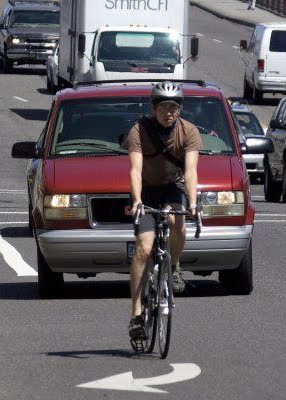
Since safety is one of the key reasons more people say they don't bike, I would say that the first finding is pretty huge. Here are some other statistics showing that biking tends to be safer (per million hours of activity) than riding in a car or on other motorized vehicles. It is also, as pointed out here in Grist, safer than doing nothing at all.

On the other hand, Rutgers has statistics quoted in this Freakanomics article that finds cyclists to be 12 times more likely to suffer a fatal crash than car drivers. Meanwhile, the same study found going by foot 23 times more dangerous than traveling by car. Now, balance those statistics against the Danish study that found non-cyclists to have a 39 percent higher mortality rate than cyclists.
What the 15-year report concludes is that pedestrian and bike fatalities have dropped 20.6 percent in the reporting period, surpassing the 10 percent improvement goal that the the Department of Transportation and the Federal Highway Administration said they were aiming for. The number of people dying in bike crashes tends to hover between 700 and 800 each year, however, which is still high, while pedestrian deaths waver between 5,000 to about 6,500.

The second finding about the increase in number of trips by foot or bike, takes statistics from the 2009 National Household Travel Survey (NHTS), walking trips accounted for 10.9 percent of all trips reported, while cycling accounted for 1 percent of all trips. Those numbers fall short of the goal of 15.8 percent of all trips NHTS was hoping to achieve by 2009. However, reported biking and walking trips reported still managed to jump 25% since 2001.

That translates to 42.5 billion walking trips in 2009, and 4 billion bicycle trips annually in the U.S.

Tuesday, June 15, 2010

6 Ways to Boost Yor City's Bike Mojo

As I watch the President speak about the oil spill, all I can think about is how cycling has a role to play in making things better for our country's oil addiction. Here are 6 steps that cities can do to make cycling more friendly for all users.

1. Make it Work for Women.


Girls Rides Baby at Portland tweed ride photo

Researchers from John Pucher to the folks at the Association of Pedestrian and Bicycle Professionals say the same thing - women are the indicator species for a well-functioning bicycle infrastructure. And here's what women want: cycle tracks - bike pathways that are physically separated from car and truck traffic. Unfortunately, cycle tracks are more expensive than simple painted bike lanes or sharrows, because they can involve breaking up sidewalks and planting physical barriers between the flow of car traffic and the cyclists. Another way to get women, especially women of all colors and younger women, out there is to sponsor more programs that emphasize the joy of biking.

2. Do That Bike Share Thing. Right Now.

Velib Pretty Cyclist in boots photo

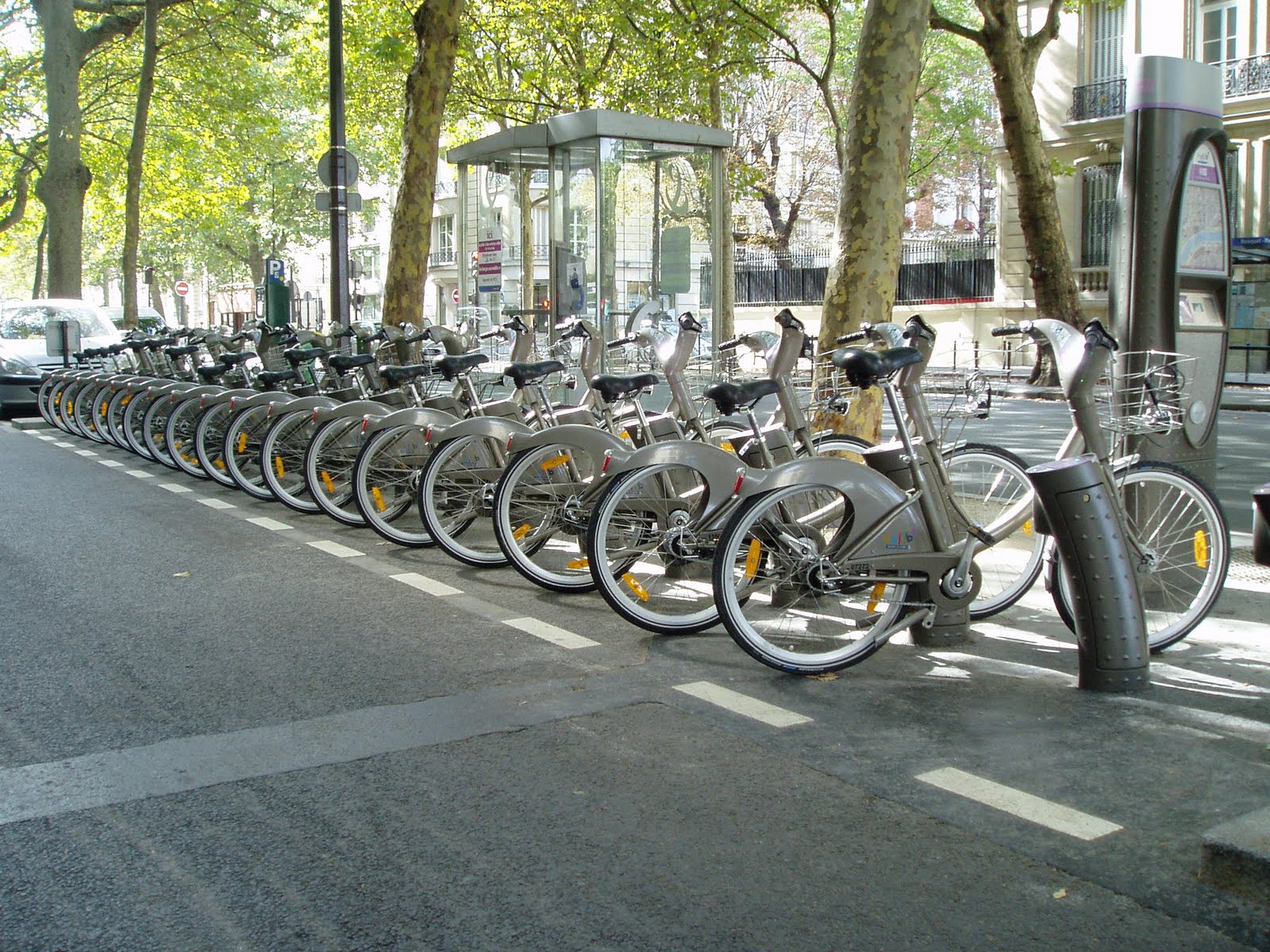
Vélib in Paris is still the best example of a bike share that began a significant change in a city's cycling habits. Paris' iconic bike share program is now a firm part of the image of the city, and has been extended out to the suburbs. But you don't need to be Paris to have a successful bike share - Washington D.C. started almost pitifully small with its bike share program but managed to capture the imagination of locals, and now its share is also expanding to include outer areas of the city - plus D.C. has a spanking new bike lane smack dab in the middle of Pennsylvania Avenue. Perhaps it's nothing more than serendipity, but a bike share is the most obvious way for a city to show its serious about attracting cycling. Cities strapped for cash can follow London's lead and get sponsored.

3. E-Bikes Are One Less Car. Support Them.

BabyOnXtracycleWithEMotor.jpg

Cycling purists tend to metaphorically spit on the likes of the electric bike enthusiasts. "Cheaters" is the most common epithet thrown at e-bikers on the bike path. But as Portland has learned, once you have early adopters of cycling out on the streets, you need to tap that core of a city population that is interested in cycling, but concerned about safety and some of the other hurdles hindering biking. E-bikes have their issues, but they provide mobility to those not ready for their first century ride or road race, i.e. the rest of the potential cycling public. A solar canopy sponsored by someone like Sanyo and shared by e-bikes and electric cars is another good goodwill offering to "One Less Car, Too" e-bikers.

4. Have a Pedalpalooza.

Sprockettes Women Dancing with Bikes photo

Currently running in Portland is a seventeen day long progressive bike festival known as Pedalpalooza. A loose conglomeration of more than 250 events, Pedalpalooza or a similar set of events allow different types of riders to find their tribe. In Portland, that can be anything from tall-bike-riding cyclists jousting with padded sticks, to "pretty panty" riders showing off their underwear, to naked cycling enthusiasts painted up and baring it all, to local city entrepreneurs networking while taking a spin through the city. Events are key to Portland's bike-friendly camaraderie and they can help new cyclists get a feeling for the city streets in a slightly-safer atmosphere. And a city doesn't need to start big - one or a series of Cyclovia-style events will almost certainly bring out riders and pedestrians to take back the streets...if only for a few hours.

5. Slow and Steady Arrives Alive.

White Ghost Bike on a quiet street photo

What many road-raged car drivers don't seem to realize is that cyclists can make the streets safer for everyone. That's because those pesky people on bicycles are a very visceral way to calm traffic. And slow traffic is safer traffic - speed limits of 20 miles per hour inside a city's inner limits can reduce traffic fatalities to next to nil because drivers have time to stop before they hit a cyclist...or a child. Portland is pursuing lower speed limits on some of the streets where it will implement bike "boulevards" - those are shared bike and car paths with street markings called sharrows or painted lanes - in order to give new cyclists the additional perception of safety they crave.

6. Re-purpose a Little-Used Stadium as a Velodrome.

Racers in Velodrome photo

One problem Portland realizes it has but doesn't quite know how to fix is putting together diverse bike subcultures into a unified voice for urban cycling. Road-race style cyclists and speeding messengers definitely were the first to take to the streets and more or less make them safer for the rest of us to get out on our bikes, and we owe them a debt of gratitude for reversing the still-prevalent trend of giving over city streets to King Car. But using the morning rush hour to do a training ride doesn't jibe with a making the inner city bike lanes friendly for the multiple styles and speeds of the next wave of bikers.

While it isn't the only solution, re-making under-used city facilities into a space for a Velodrome for track-style bicycle racing is one way to boost the profile of sporty cycling at the same time that a city tries to foster good manners and civilized speeds on the streets of the inner city.

(April Streeter, Treehugger.com)

Monday, June 7, 2010

Chicago Gets Artistic Bike Racks

Chicago cyclists soon will be getting a little culture with their theft deterrence if the City Council approves a plan to allow artists to design special racks for riders to lock up their bikes. The need for more racks has come about because of the city is removing parking meters and switching to pay-and-display boxes. This is going to cost bicycle riders thousands of parking spaces. They used to hitch their wheels to meters, and now they can’t. The city has 10,000 regular bike racks in the city, but with the ever increasing cycling population, they need to supplement the lost meter poles.


Neighborhood groups and chambers of commerce would pay for the racks and get a lot of say in picking the designs under a measure the council's Transportation Committee adopted today. Artist-designed bike racks have become a draw in places like Austin, Los Angeles, Louisville, and several other US cities. Louisville is up to 32 racks since a downtown association started commissioning them nine years ago.

It's doubtful the rack art will be as popular as Chicago's 1999 "Cows on Parade," but they could be a hit with Chicagoans and tourists.

Air Pollution and Cyclists

I always thought that getting some fresh air on a ride is refreshing, but a new UK study reported  in the Times shows cyclists can be among the most vulnerable to dirty, particulate-rich city air, inhaling five times moe toxic nanoparticulates than pedestrians or car drivers.

The study, led by Luc Int Panis of the transport research institute at Hasselt University in Belgium, had participants fit a breathing device over their mouths while riding through the cities of Brussels as well as the smaller nearby Mol.

In Brussels cyclists inhaled 5.58 million nanoparticles for every meter cycled. In Mol, just 1.1 million nonparticles were inhaled by study participants. The study found cyclists inhaled four to five times more particles than a car passenger driven along the same route. Cyclists are more at risk than car passengers not only because they are in the open air but also because exertion makes them breathe both harder and faster.
Another study soon to be released by the journal Epidemiology shows that these nanoparticles may contribute to a higher risk of heart disease and more risk of asthma attacks.

I think that it is far better to have this information than proceed as if pollution doesn't matter, but I think that if we do a few things, we can make the air pollution better for everyone

1. Continue to encourage people to bicycle because the outcome is healthier than if they sit in a car. People don't have to bicycle in polluted routes for 2 hours each day whereas they often sit in cars in polluted sections for that amount of time.

2. Choose routes to bike that are away from the heavy arterials or downtown roads that have 4 to 6 lanes of traffic and multiple buses, trucks, and stopped cars. Parallel routes for bicycling, such as designated bike boulevards, are better than heavily congested roads, especially if on the other side of tall downtown office buildings

3. Create cycle tracks that allow the bicyclists to not bicycle directly behind the buses and trucks, ideally with a buffer (trees, parallel parked cars) between the buses/cars/trucks and the bicyclists on the cycle track.

4. Encourage cities to start adopting policies to reward the purchase and driving of non-polluting cars, trucks, and buses, especially in city centers. Most other countries make it a pain in the pocket book to drive a car with higher taxes, fuel costs, and parking. The harder it is to drive, the easier it is to get on a bike.

Sunday, June 6, 2010

New York - Part 1

Sorry for the lull in posts, but I have been in New York for work for the past week, and will be here until next Thursday.Yesterday was my first chance to get out and explore, and let's just say that pedaling the city did not disappoint.

I rented a city hybrid, helmet, and lock for $40 flat from a bike shop near Bryant Park and headed out. The choice of where to rent was based on being located in the middle of the city and getting me up to Central Park, down Broadway and Times Square, and then looping back up the Hudson River Bike Path. In my 4 hour ride I covered about 50 miles and saw more of the city than I ever would have been able to on foot.
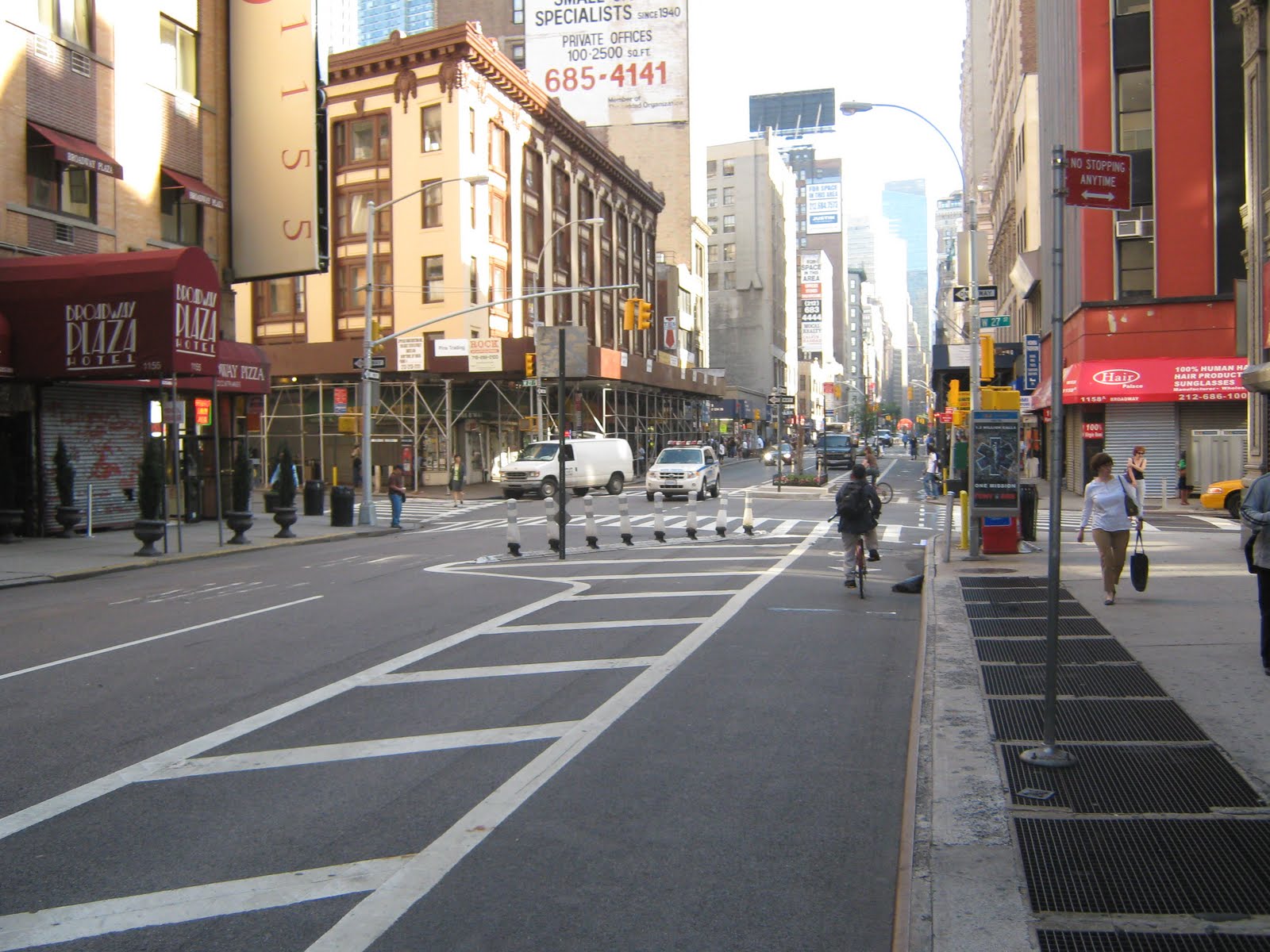
The facilities and riding styles in this city vary and are as wild as anyone can imagine. There are bike lanes on most of the streets and many of them are at least 6 foot wide and have a 3' striped buffer zone. They also have green painted intersection crossings and have bike stop lights on their larger streets, so that bikes get a few second jump on the traffic behind them that may be trying to turn.

The comfort level of riding here is surprisingly high, from what I think that many would perceive it to be. Bikes are highly respected by the cabs, buses, and other traffic, because bikes are everywhere. The majority of the riders are bike delivery and messenger people, but there are many people out riding for commuting, touring the city, and just for fun. Riding in NYC is just like riding anywhere else, don't do erratic/unpredictable moves, use hand signals to show lane changes, and keep your head on a swivel for possible conflicts that can be prevented.

I will break down more of what I saw and did out there in future posts.

Tuesday, June 1, 2010

Grown-Up Cyclists Need Helmets, Too

Ruby Washington/The New York Times Catherine Talese always wears a helmet on her bike rides throughout New York.
Today’s Patient Money column explains what to look for when buying a bike helmet, essential armor for adults as well as children.
Bicycle helmets have been shown to reduce the risk of head injuries by up to 88 percent and facial injuries by 65 percent, according to a Cochrane Database Systemic Review published in 2000. Bike riders who play against those odds do not fare well in accidents. More than 90 percent of the 714 bicyclists killed in 2008 were not wearing helmets, according to the Insurance Institute for Highway Safety….
BE A ROLE MODEL
Wearing a helmet sets a good example for other riders and for children.
“We see plenty of kids in our trauma center who say they have helmets at home,” said Dr. Beth Ebel, director of the Harborview Injury Prevention and Research Center in Seattle. “The biggest problem with kids is getting them to wear their helmets consistently.”
Adam Bluestein, who has two children and lives in Burlington, Vt., never rides without a helmet. “I want my kids to know that always riding with a helmet is important. Now when we see people riding without a helmet, it’s like seeing someone smoking a cigarette — the kids practically gasp in horror. ‘How could someone do something so unsafe?’ ”
To learn more, read the full column, “Grown-Up Cyclists Need Helmets, Too,”

Wednesday, May 26, 2010

Safety in Numbers

"Active Transportation for America" makes the case and quantifies the national benefits—for the first time—that increased federal funding in bicycling and walking infrastructure would provide tens of billions of dollars in benefits to all Americans.

By making active transportation a viable option for everyday travel, we will cost-effectively reduce oil dependence, climate pollution and obesity rates while providing more and better choices for getting around town.
 

Simply increasing bicycling + walking from 10% to 13% of all U.S. trips could lead to fuel savings of 3.8 billion gallons a year, equivalent to replacing 19 million cars with hybrids.

Read the report to learn more about how adequate federal investment in bicycling and walking will create healthier places for healthier people.

My favorite section breaks down my theory on more people on bikes = higher comfort and safety levels for cyclists. Designing communities to foster active transportation improves the safety of bicyclists and pedestrians.
In 2006, more than 4,784 pedestrians and 771 bicyclists were killed on U.S. roads. Despite this disproportionate share of fatalities, federal funding to address bicycle and pedestrian safety has been sorely lacking.

In European countries that have invested considerably in bicycle and pedestrian infrastructure, such as Germany or the Netherlands, fatality rates for non-motorists are about 10 times lower than in the United States. Australian cities also report increased safety for bicyclists as a result of infrastructure investments and increased bicycling.

Portland, Ore., is a prime example of how investment in bicycle infrastructure results in increased safety. Since 1991, Portland has steadily expanded its network of bicycle facilities, and observed a constant growth in bicycling, while crash and fatality rates among cyclists significantly decreased. Between 1991 and 2006, Portland was able to reduce the crash rate by more than 69 percent. In that time period, the number of bicyclists grew more than four fold, while the number of fatalities remained low, between zero and five per year.

Infrastructure investments are clearly an effective and necessary measure to increase the safety of cyclists and pedestrians. Additional measures, such as education of motorized and non-motorized traffic participants, and various forms of traffic regulations can further improve safety. Simply said, there is safety in numbers and the fastest way to increase numbers is to invest money in facility infrastructure.

Sunday, May 23, 2010

7-Tips for Bike Commuting

You might have excuses for not riding your bike to work--and if you do, Bicycling Magazine has answers for all of them. Today is National Bike To Work Day. To celebrate, here are some great tips to help you make the leap to healthy, low-carbon commuting.

Traffic Scares Me
Two simple principles greatly improve your safety: ride predictably and ride visibly. On wide roads, ride just to the right of the traffic lane; on narrow roads, stay just inside the traffic lane so vehicles must partly cross the middle line to pass. (This removes the temptation to try to squeeze by you.) For turns, work your way into the proper lane 150 feet early; if you can't get there 40 to 50 feet before the turn, go straight and double back. Stay several feet away from curbs--passing autos push debris to the curb, creating a littered path.
I don't Have Time
Studies by groups such as New York City's Transportation Alternatives have shown that trips of less than 3 miles are often quicker by bike, and urban trips of 5 to 7 miles usually take about the same time. Plus, you can use your ride to work as an extra cardio workout. The average American drives 29 miles per day. If you substitute one day’s worth of driving with riding per week, in a year you’ll burn enough calories to lose 19 pounds. You’ll also reduce auto emissions by 1,248 pounds of CO2, and save more than $800 on gas and maintenance.
I'll Smell

If your office has showers, drive once or twice a week, carrying a few days' worth of clothes you can store there. Or, you could shower at your gym if it’s near your office. If neither of those is an option, wear a sweat-wicking jersey and bike shorts on your ride in. After arriving, wait 10 to 20 minutes for your body to stop sweating, then wipe off with baby wipes If you showered that morning, you should be suitably fresh.
There's No Place to Keep My Bike
To lock your bike safely out on the street, use two different types of locks, such as a U-lock plus a chain-and-padlock. (That forces thieves to carry several tools--which means they'll look for easier prey than your bike.)
I Live Too Far Away
Can't commit to 15 miles or more each way? Cut the mileage in half: The first day, drive to work with your bike, then ride home that night. Ride to work the next morning, then drive home. Repeat euphorically.
I Have to Drop the Kids Off

Drive your kids to school and ride the rest of the way to work. Or, organize a car pool in your neighborhood. Or best of all, ride with your kids to school--they'll be the envy of their class. If you carry them in a trailer or a trail-a-bike you can often arrange to leave it at the school until you return.
My Boss Says No
Tell them it'll improve productivity and reduce absenteeism: 80 percent of people who switch from driving to bike commuting improve the function and health of their heart, lungs and blood vessels in 8 weeks, according to the advocacy group Transportation Alternatives.
Transportation for America Coalition