Showing posts with label Innovation. Show all posts

Wednesday, July 3, 2013

Rubberized Asphalt In Bikeways

soft-sidewalks-to-reduce-bicycle-crashes
I saw this and I couldn't resist researching it a bit deeper. I also immediately wondered why no one ever thought of this before now. Leave it to the Swedes (who have taken a pledge to reduce traffic deaths to zero, and actually work toward that goal) to create a better material with which to make bike paths safer. At the Swedish Royal Institute of Technology (KTH), researchers are working on a new form of asphalt that has enough friction to reduce bicyclists' slide-outs, while at the same time it cushions vibrations if a cyclist does fall.

Regular asphalt uses crushed stones and bitumen, a petroleum byproduct, as a binding agent. KTH's researchers are working to blend in just the right amount of recycled tire rubber from old car tires to soften up the mix.

The first step is lab testing, then real-world road tests on areas where there have been frequent bike accidents. The Swedish Traffic Administration is paying special attention to cyclists as one of the transport groups suffering more injuries than car, truck, or public transport riders. About 1,500 cyclists are hospitalized in Sweden with serious injuries each year - a number almost 10% higher than the number of car passengers injured. Another hope is to find a formula for asfalt that also reduces wear and tear on bicycle tires.

Monday, June 3, 2013

New Vending Machines for Cyclists

Express Biker bike parts vending machine
A company called Express Biker has created a self-serve vending machine that sells bike parts. The goal is to help cyclists who might be riding late at night or far from bike shops, where getting a flat tire (for example) would be very inconvenient. The vending machines will sell things like tubes, lights, co2, patch kits, various tools and parts.

There are already two machines in function in Brooklyn: One on the border of South Williamsburg and Bedford-Stuyvesant at the Emporium Gas Station on Flushing Avenue, and one at the Mobil Gas Station at 415 Empire Blvd. a few blocks away from Prospect Park. They want to partner with outdoor locations near major bike routes throughout NYC that are open for 24 hours, such as gas stations, parks, etc.

It reminds me a bit of this free-to-use bike repair station, though this one only has tools and an air pump (these should be everywhere, in my opinion):

Boston is also getting vending machines, but for bike helmets. As programs for renting bikes expand across the nation, so too do programs and infrastructure that support cyclists -- and Helmethub's aim is to keep cyclists safe, and without an excuse for riding helmet-less.

helmethub imageHelmethub is launching a solar-powered vending machine in Boston in July. The vending machines, each holding 36 helmets, will be located next to Hubway locations, the city's bike-sharing program. Cyclists will be able to rent helmets for about $2.00 at the same time they pick up their rented bike. The machines can even dispense three different sizes of helmet to make sure it fits the user correctly.

When helmets are dropped off by users after use, they're picked up by the team and sent to Helmethub headquarters to be inspected and cleaned before being placed back in the vending machines. The machines provide real-time info to the team so they know when each machine needs to be restocked, or used helmets need to be picked up.


I love seeing this initiative to keep cyclists safe, especially those who are renting bikes and so are less likely to own their own helmet. We'll see how Helmethub's new program works throughout the summer and if it is successful, perhaps other cities will adopt the system to go with their bike-share systems as well.

Tuesday, May 7, 2013

Wireless Bike Brake Light


I've reviewed a lot of bike lights and this new one is a little different. Inventor and tinkerer John Craig has created an easily removable, battery-powered brake light that senses a cyclist's decelerations in order to strongly flash when a bike is coming to a stop.

Calling his new Kickstarter campaign invention the LucidBrake, Craig says the light will help save lives by preventing some of the accidents caused by drivers that say they just don't 'see' cyclists. The LucidBrake has a patent-pending algorithm that is supposed to ignore normal wheel rotations and road bumpiness, yet sense the deceleration that indicates slowing down or stopping. The brake's eight LED lights are placed in an octagon shape so that they resemble a stop sign.

For regular cruising the LED-based LucidBrake shows a weaker flashing light, then flashes intensely when the cyclist is braking or decelerating to a stop. The light stays steady for a few seconds and then returns to weaker flashing. There are no wires or installation, and no plastic parts or covers. LucidBrake weighs in at just 23 grams and the company says it is easily mounted and dismounted from a bike (though a flat surface is needed), or a helmet, or a backpack. The LucidBrake team consulted 3-M to find a 'dual-lock' fastener, a bit like sticky velcro, to make it easy to put the brake light on and off. Craig says a tough sunlight and waterproof coating means you can dunk a Lucidbrake in a lake and it keeps on flashing.

LucidBrake isn't the first wireless brake light, but with the eight LEDs it does seem one of the brightest. At the current Kickstarter, getting one of the first-production lights entails a $50.00 pledge.

Wednesday, October 10, 2012

World's First Chainless Folding Electric Bike


The Footloose by Mando is doubtless going to make you want to test ride it. Asserting that it is the world's first chainless hybrid electric folding bike, Korean auto suppliers Mando Corp and Meister Inc have collaborated to bring us this beautiful design.

Designboom states it can go up to 18.6 miles with the motor alone, and farther with pedaling by the rider. "By directly transforming electricity via an alternator connected to the crank, power is generated directly from the user. The energy stored in a lithium-ion battery, which is then used to actuate the engine. Using an electronic control unit (ECU), the 'footloose' works with sensors and an automatic gear changer to monitor terrain and adjust the motor's output as necessary. It monitors the system for problems, which it displays via a handlebar-mounted human machine interface (HMI)."
As Gizmodo puts it, "It's like the bicycle equivalent of the Chevy Volt."

And as we mentioned, there is no chain so added to the extra perk of being able to fold it is it's ability to fold to a very small size:

It will apparently be available in the European markets starting next year. Here is a video illustrating the bike a bit more:

Wednesday, October 12, 2011

Bike Lock That Looks Like a Water Bottle


bottle lock image
I've seen a lot of clever bike lock designs, but the Küat Racks Bottle Lock is definitely unique. This is a great gadget for cyclists -- a bike lock that stores as the same size and shape as a bottle of water so it fits right in your water bottle rack.
bottle lock image
bottle lock imageBike theft is a real problem, but that doesn't mean ugly bike locks have to be an unfortunate side effect of bicycling around town. Most locks look rather ugly when they aren't in use. Usually they just sort of hang from your seat, haphazardly wrapped up and waiting to be looped around a lamp post.

The Küat Racks Bottle Lock has a 5-foot long cable of 7.5mm braided steel that rolls up to store in the bottle-shaped case. It includes two keys and a lock, which can also be stored inside the "bottle", and weighs just 14 ounces. It would have an expected sale price of $34, if it makes it onto store shelves. That's really not so bad for a stylishly-hidden lock for your bike.


The only problem, of course, is where does your water go?

Tuesday, October 11, 2011

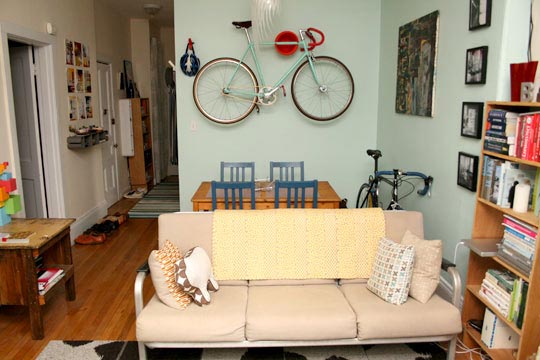
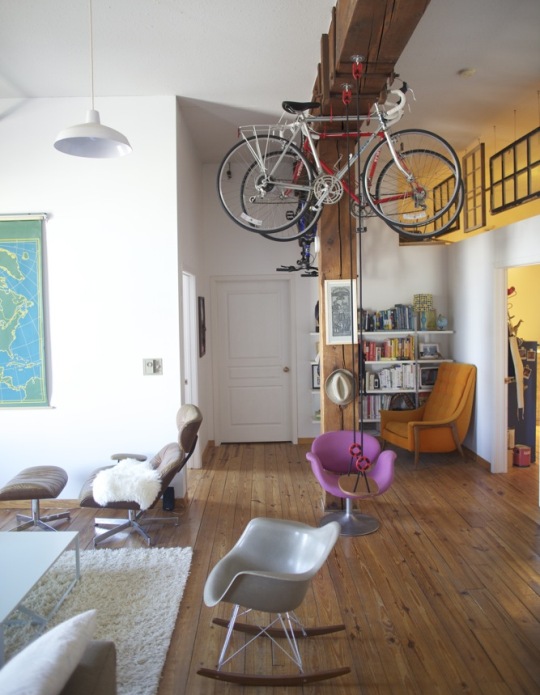
Apartment Bike Storage Solutions


Sure, bicycling is a fun and earth-friendly way to get around. But if you have to store your bike inside your apartment for one reason or another, they can begin to take over your place if your home is challenged in the size department. Below are some great products and solutions that will help organize all your rides.

Bike shelf systems can easily be found on Etsy.com. They can range from sleek to crafty to rustic. All play on the idea of the shelf and are a great solution if you have ample horizontal wall space.

If your space is a bit smaller, a vertical solution might be a better bet. The Cycloc lets you hang your bike along any wall, and gives you a small storage space for riding accessories.

A bigger challenge comes when you're sharing a space with another biker or are a bike enthusiast with more than one bike. If you've got multiple bikes, try this system.
10-23-08ikea5.jpg
Taken from IkeaHacker, you can construct this bike rack using just a few simple pieces of hardware from Ikea: a Stolmen post, a couple of brackets, and four hooks.
10-23-08ikea2.jpg
Building the rack works as follows:
10-23-08ikea3.jpg1. Cut two pieces of the square pipe; choose the length depending on the design of your bike frame.
2. Drill 3 holes into the pieces of square pipes.
3. Screw a hook on each end of the pipe; screw the pipe to the bracket.
4. Now you can mount the stolmen post and adjust the two brackets on it.
5. Finally glue some of the rubber foam to the hooks to not scratch the bike frame.
Total cost? Just over $40, and should just take ½ an hour to construct.

You could store it on the ceiling. It looks great; the challenge will be getting it down. This might be a better idea for longer term storage.

Thursday, September 29, 2011

What is the 'ultimate utility bike'?

Fuseproject Bike Full Length photo

On the heels of the Oregon Manifest Construction Design Challenge 2011, Oregon Manifest aims to find out what bikes we like. They attracted a big batch of entries - 31 altogether - yet the judges' winning pick also set off a web storm of criticism. This year's group of entrants included a trio of special collaborations. IDEO and Rock Lobster, Fuseproject and Sycip, and Ziba and Signal teamed together to show what would happen when bike builders conspired with renown industrial and product designers. Now the show's organizers want to know what we all think. Take a look at the three collaborations' resulting bicycles here and register your vote over here.
The Local utility trike bike photo

The Fuseproject Local trike shown above, designed by Jeremy Sycip and Yves Behar, puts cargo carrying up front, is just 40 pounds total weight and has an ingenious built-in front u-lock to make it less awkward to park a three-wheeler. In a perhaps shameless bit of product placement, it has Fuseproject's own wireless Jawbone Jambox speaker on-board.
The Faraday bike photo

The IDEO/Rock Lobster Faraday takes electric-assist to a whole new level of pretty. The leather-trimmed Faraday has the e-bike battery fitted into the top frame tube, and wiring and electronics run in the down tube. Because the run time is short (30 - 40 minutes), the Faraday can be quickly re-charged in just 10 minutes. And the cargo isn't neglected here - the front rack is integrated into the frame for smooth hauling. Very strong and practical integrated LED lighting front and back, too.
Detail on the Faraday bicycle photo

The Fremont bike photo

Ziba/Signal's Fremont bike lets you carry your cargo carrier with you - the sidecar, with a smart integrated canvas bag (it has a locking mechanism to keep it attached) can be literally folded on top of the back rack when not in use. The roomy bag can also fold flat to allow for other bulky parcels in the sidecar. The lower-slung mixte frame on the Fremont is meant to make it appeal to both men and women, as step-though is easier than on a diamond frame. Last but not least, the Fremont has a handy, integrated braided cable lock and extra pin mechanism that locks the steering.
The Fremont cable lock detail photo

Tall Guy Rides the Fremont photo

So, which bike could you see as a cargo-hauling car replacement? Vote here.

Wednesday, September 28, 2011

E-Bike Design Wins Bike Design Challenge


Tony Pereira's Ebike.jpg

The Oregon Manifest 2011 Constructor's Design Challenge was meant to get custom bike builders to come up with some innovative and snazzy new utility bikes, in the hopes that their best and brightest ideas will trickle in to the cycling mainstream. This year's top winner ($3K in prize money) was Tony Pereira's entry, a pretty hot pink bike with a carbon fiber front-rack lockbox with slots for stereo and phone, an integrated u-lock, and a zippy electric assist engine. Pereira's addition of electric assist seemed to open the judges' minds to the possibilities of e-bikes. Pereira managed to make his e-bike look fairly streamlined - its battery is housed in a black box under the top frame tube, fairly reminiscent of the '50s gas-tank bikes made to resemble motorcycles.
"2011 is almost over, but 2012 will definitely be the year of the e-bike." - Tony Pereira
Pereira, who also won the top prize in the 2009 Oregon Manifest challenge, is well-known in craft bike-building circles for his beautifully sleek steel frames. In that year's competition, part of his bike's winning credentials was the integrated u-lock in the frame.
University of Oregon bicycle design entry photoThis year, integrated locking systems abounded in the bike entries, as security was one of the competition's criteria. None of the other entries seemed to match Pereira's bike's elegance and impressive feature set.

Though Pereira's bike doesn't move us beyond our conception of what a bicycle should look like (as the University of Oregon's entry does), it manages to take existing technologies - usually a plus for reliability and interoperability - and combine them in a truly pleasing and ready-to-ride way.

The bike used a BionX electric-assist hub-based regenerative motor. The system has four separate levels of assist, and at the lowest level of assistance has a maximum range of 60-65 miles. That's quite a bit better than current e-bikes such as the Sanyo Eneloop, which has a 17 kilometer range.

Pereira said he built the bike with his own cargo-hauling needs in mind - the cargo being his young son. On the 51-mile race that tested the mettle of the Manifest bikes, Pereira was pleased that intermittently deploying the assist for the first 30-miles had used less than 50% of battery capacity.

The electric assist added 15 pounds to the bike's weight, which came in at approximately 60 pounds. Pereira's bike seems to signal that utility and cargo bikes will gain their widest acceptance if they have, or can be retrofitted with some type of assist. Here's Oregon Manifest judge Bill Strickland of Bicycling Magazine on Pereira's winning design:
"When Tony came in for his presentation, he told us, 'This is a replacement for a car.' It's got an engine, a locking trunk and a radio."

Thursday, September 22, 2011

Ford Is Making e-Bikes

ford e-bike image

Joining Daimler's smart car, BMW, Audi, and Land Rover, Ford Motor has joined the E-Bike world with a two-wheeled concept vehicle the automaker debuted at the current Frankfort Auto Show. Recognizing the growing electric bicycle market (30 million sold worldwide last year), Ford is on board the "bike wagon" along with making electric 4-wheeled vehicles.

Ford's E-Bike idea is the latest news. The trapezoidal frame is targeted for both men and women and the lightweight lithium-ion battery of aluminum and carbon fiber weighs just 5.5 lbs and is concealed within the frame. With a range of 53 miles per charge, the design will offer effortless Economy, Comfort and Sport rides with data displayed at your fingertips noting speed (up to 15 mph), distance covered, etc.

Ford's E-Bike doesn't go into production any time soon, but shows what the US automaker is thinking about the future of transportation. I'd heard Bill Ford at TED Talks earlier this year discussing the solutions in the works for "smart cars" that talk with each other as a way to address global gridlock and then saw it in action at the company's Forward with Ford conference, which explored what's ahead from Fusion and Focus, as well as lightweight plastics, natural fibers and recycled materials already used in the interiors.

This E-Bike design also integrates "magneorestrictive" sensors, borrowed from Formula One cars, that activate and deactivate the motor within a fraction of a second, which Ford claims is the first time this technology will be implemented with a bike.

Source: AFP's RelaxNews via The Independent UK

Wednesday, September 14, 2011

Built In Bike Lock

Andrew Leinonen staylocked bike frame and lock photo

Andrew Leinonen staylocked bike frame and lock photoThere is the basic bike rule that the lighter the bike, the heavier the lock. Toronto designer Andrew Leinonen breaks the rule; in his new design, the bike is the lock. It's really clever; the lock is an integral part of the frame, and without it, the bike is unrideable.


Andrew tells Herb at iBikeTO:
Putting my mind to the endemic problem of urban bike theft, I realized that in a big city like Toronto or NYC, any lock (no matter how bulky or heavy) can only serve as a deterrent for a determined thief with the right tools. This challenge was the inspiration for the StayLocked bike, a design that integrates the lock directly into the frame. The bike's seatstays have been replaced with a U-lock on a pivoting joint. This is a 'scorched earth' approach; any thief that breaks the lock breaks the bike as well, rendering it unrideable and without value.

Andrew Leinonen staylocked bike frame and lock photoAndrew Leinonen staylocked bike frame and lock photoWhen riding the bike, the U-lock shackle is securely clamped into the rear triangle, but when the rider wants to lock up the bike, they simply unlock the shackle, swivel it into place around the post (or whatever) they are locking to, and slide on the lock body, as with a standard U-lock. Using the lock is instantly familiar, and doesn't require that riders change their behaviour or carry anything with them besides a key. It even saves weight, since you don't need to bring a heavy lock or chain with you (and a rack or bag to carry it with).
Because the U-lock replaces part of the frame, there is much less additional weight to carry around, and it eliminates the possibility of forgetting your lock. Furthermore, the bike thief doen't get anything for their work, the bike will fold up under them. Just don't ever lose your key.

Monday, April 11, 2011

New Design for Bike Racks on the Sides of Buildings

Bike parking in most big cities is a tough battle for available, usable space. There's never enough of it for the simple reason that parking (especially the good kind, like sheds) hogs precious real estate that dense regions either don't have or can't afford to cede. One architect's solution: Stash bikes in something cities have in abundance -- the air.
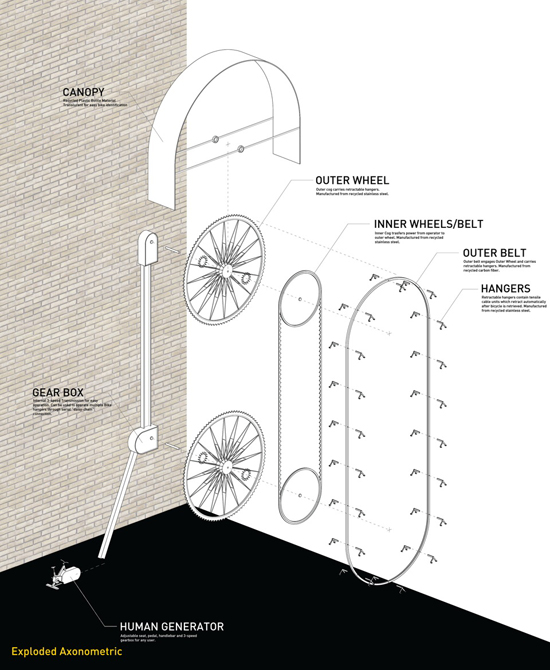
Bike Hanger is a proposal by New York-based Manifesto Architecture to hang bikes clear off the side of buildings. A ferris wheel-esque frame latches onto to under-used facades -- the back of apartment towers, underpasses, etc. -- and works like a human-powered conveyor belt. Pedaling on a stationary bike nearby powers the wheel, forcing it to rotate. Cyclists then hoist their bike up on a T-shaped rack. When they're ready to take it down, they (or a bike-rack assistant, it's not clear who'd do the work here) would cycle away on the stationary to return their bike to the ground. In short, it's the two-wheel equivalent of stack parking, only greener; the architects say it wouldn't require any extra mechanical juice.
Manifesto Architecture came up with the concept explicitly for Seoul (a city that's almost twice as dense as New York!) though clearly, it'd work in any big metropolitan area where bike parking is in short supply.
Mind you, there are details to hammer out. For one, Bike Hanger would need some killer locking mechanisms, otherwise it's a just a thefts' paradise. Secondly, the wheel holds only 20 to 36 bikes. As a comparison: Many of the bike lockers in the San Francisco Bay Area can hold 100 sets of wheels or more.
So it's a lot of work for not a lot of storage. But when you think about all the weird, interstitial areas of a city, it starts to make sense. If the big push is to put more bikes on the street, then it's only logical to work with the character of the city you've got.

More images and info at ArchDaily.com
Transportation for America Coalition