Monday, June 7, 2010

Air Pollution and Cyclists

I always thought that getting some fresh air on a ride is refreshing, but a new UK study reported  in the Times shows cyclists can be among the most vulnerable to dirty, particulate-rich city air, inhaling five times moe toxic nanoparticulates than pedestrians or car drivers.

The study, led by Luc Int Panis of the transport research institute at Hasselt University in Belgium, had participants fit a breathing device over their mouths while riding through the cities of Brussels as well as the smaller nearby Mol.

In Brussels cyclists inhaled 5.58 million nanoparticles for every meter cycled. In Mol, just 1.1 million nonparticles were inhaled by study participants. The study found cyclists inhaled four to five times more particles than a car passenger driven along the same route. Cyclists are more at risk than car passengers not only because they are in the open air but also because exertion makes them breathe both harder and faster.
Another study soon to be released by the journal Epidemiology shows that these nanoparticles may contribute to a higher risk of heart disease and more risk of asthma attacks.

I think that it is far better to have this information than proceed as if pollution doesn't matter, but I think that if we do a few things, we can make the air pollution better for everyone

1. Continue to encourage people to bicycle because the outcome is healthier than if they sit in a car. People don't have to bicycle in polluted routes for 2 hours each day whereas they often sit in cars in polluted sections for that amount of time.

2. Choose routes to bike that are away from the heavy arterials or downtown roads that have 4 to 6 lanes of traffic and multiple buses, trucks, and stopped cars. Parallel routes for bicycling, such as designated bike boulevards, are better than heavily congested roads, especially if on the other side of tall downtown office buildings

3. Create cycle tracks that allow the bicyclists to not bicycle directly behind the buses and trucks, ideally with a buffer (trees, parallel parked cars) between the buses/cars/trucks and the bicyclists on the cycle track.

4. Encourage cities to start adopting policies to reward the purchase and driving of non-polluting cars, trucks, and buses, especially in city centers. Most other countries make it a pain in the pocket book to drive a car with higher taxes, fuel costs, and parking. The harder it is to drive, the easier it is to get on a bike.

Sunday, June 6, 2010

New York - Part 1

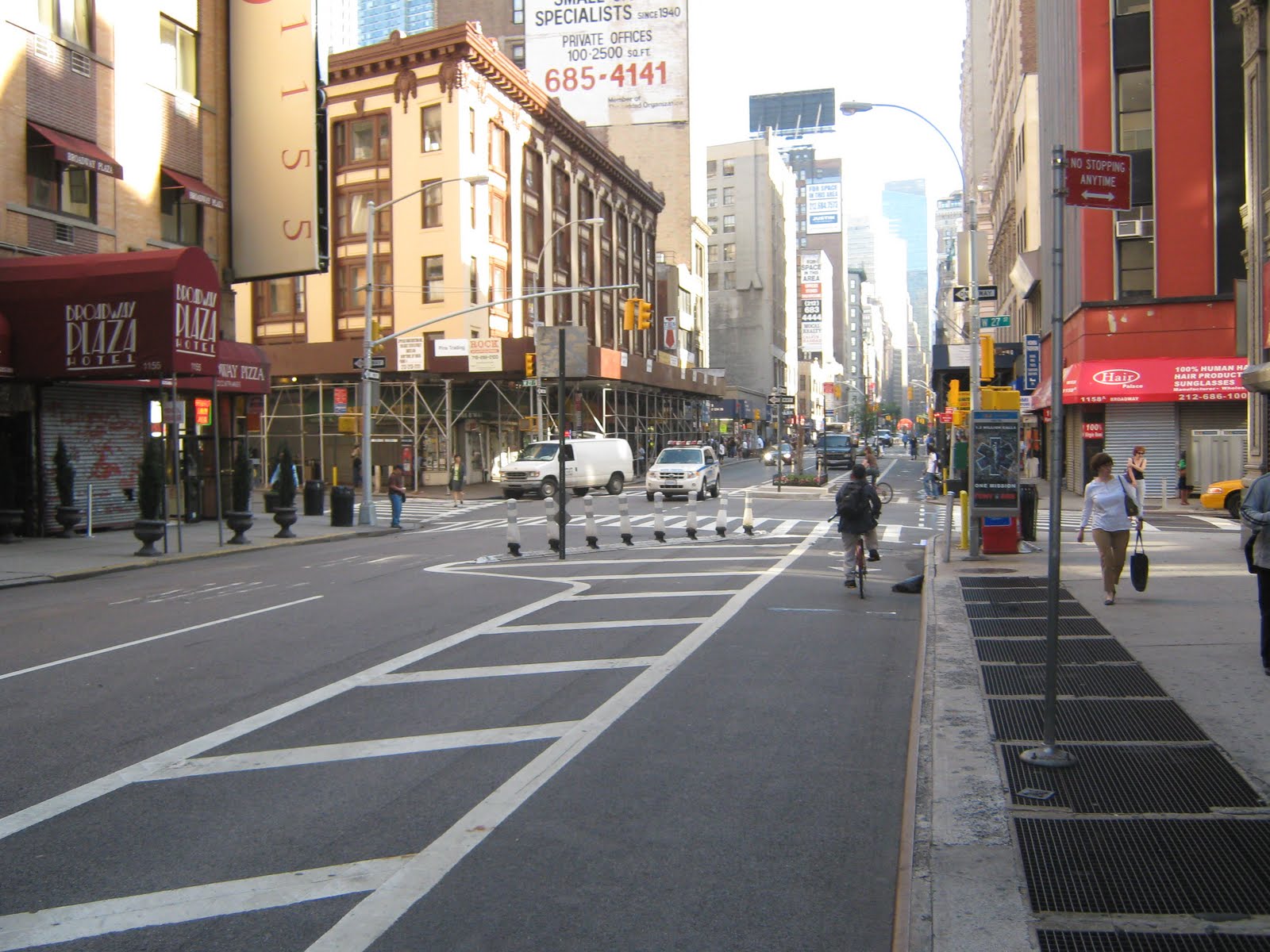
Sorry for the lull in posts, but I have been in New York for work for the past week, and will be here until next Thursday.Yesterday was my first chance to get out and explore, and let's just say that pedaling the city did not disappoint.

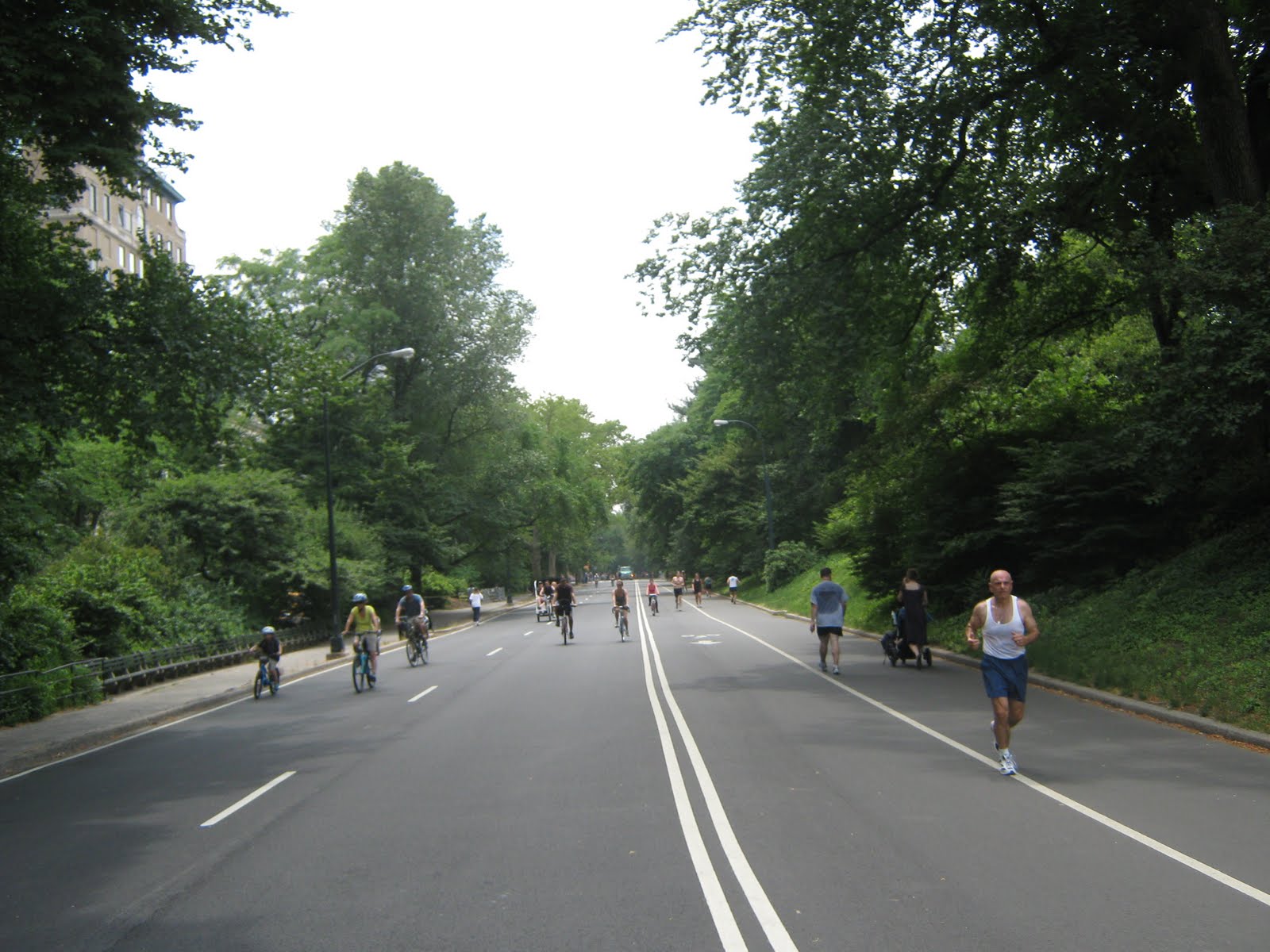
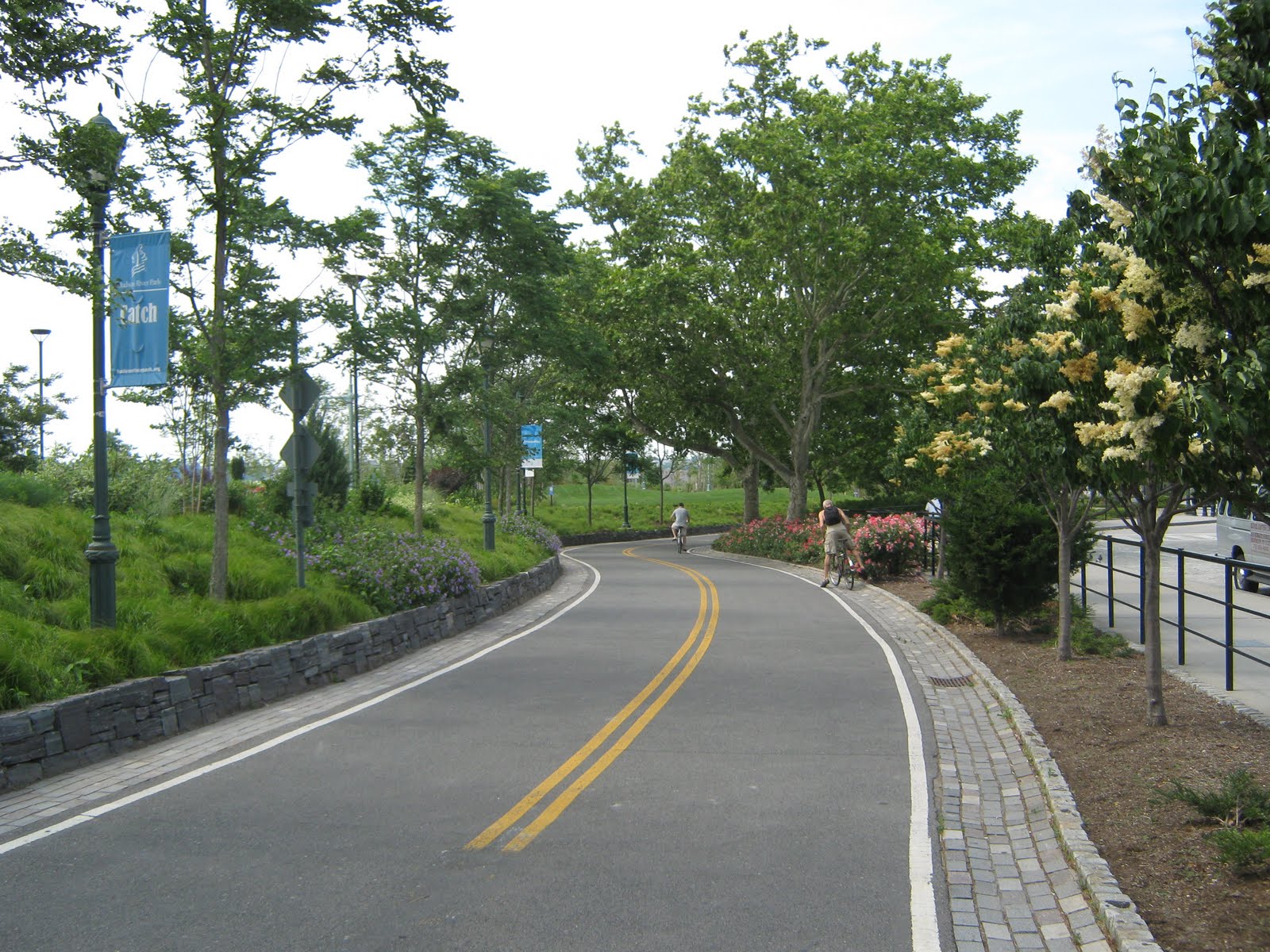
I rented a city hybrid, helmet, and lock for $40 flat from a bike shop near Bryant Park and headed out. The choice of where to rent was based on being located in the middle of the city and getting me up to Central Park, down Broadway and Times Square, and then looping back up the Hudson River Bike Path. In my 4 hour ride I covered about 50 miles and saw more of the city than I ever would have been able to on foot.
The facilities and riding styles in this city vary and are as wild as anyone can imagine. There are bike lanes on most of the streets and many of them are at least 6 foot wide and have a 3' striped buffer zone. They also have green painted intersection crossings and have bike stop lights on their larger streets, so that bikes get a few second jump on the traffic behind them that may be trying to turn.

The comfort level of riding here is surprisingly high, from what I think that many would perceive it to be. Bikes are highly respected by the cabs, buses, and other traffic, because bikes are everywhere. The majority of the riders are bike delivery and messenger people, but there are many people out riding for commuting, touring the city, and just for fun. Riding in NYC is just like riding anywhere else, don't do erratic/unpredictable moves, use hand signals to show lane changes, and keep your head on a swivel for possible conflicts that can be prevented.

I will break down more of what I saw and did out there in future posts.

Thursday, June 3, 2010

Florida Racing Magazine June Issue


Bike Polo


In my personal life, cycling is a distance/speed sport. Packs of riders, neatly turned out in team jerseys, whiz silently along winding roads, across a landscape of wooded natural areas and open fields. Shortly after dawn on a weekend morning there can be 100 or more in a group, a homegrown peloton that meanders mile upon mile as it leaves civilization behind.

In the city, riders are just as serious about their cycling. But in some cities, the feel is entirely different.
Hardcourt bike polo is like pickup basketball on wheels. I found this video online from Washington DC, it is played in a pickup basketball court. Three-on-three teams go at it hard (five goals wins) before the losers retire to the sideline to schmooze and smoke with other players waiting their turn.

There are no smooth Pearl Izumis kits here. Many of the men and women under these lights on a warm spring evening could be mistaken for bike messengers or petty cab drivers. Tattoos and piercings abound. Trash talk is encouraged. Road rash is inevitable.


Bike polo is simply riding fixed-gear or low-gear bikes, one hand on the handlebars, the other holding a homemade mallet, players chase a street hockey ball around a rink about the size of a basketball court -- sprinting, stopping, starting and mixing it up in the corners, in a game that crosses polo and street hockey. The mallets are constructed from a short length of high-density gas pipe or industrial plumbing plastic bolted to an old ski pole. The low boards around the rink are also homemade. Each goal is defined by a pair of traffic cones. Most riders have installed spoke covers to deflect hard shots.

Almost everyone wears a helmet, and some wear knee and elbow pads, because collisions and falls are frequent, though the night ends with all collarbones intact. There are surprisingly few rules: no T-boning, give a competitor a fair line to the ball, no hard contact with new players. No quarter is given to women, who don't want it anyway.

The game emphasizes control, maneuverability and technique over speed.While the players hold their bikes still as they battle for the ball or block the goal, you can't put your foot down That results in a violation that results in the penalized player pedaling to midcourt and touch the side wall before they can resume playing.

The current incarnation is generally credited to a band of Seattle cyclists, many of them messengers, who started playing and compiling rules about 10 years ago.Now bike polo is played in cities across the United States, Canada and Europe. There are North American, European and world championship tournaments.

Tuesday, June 1, 2010

Grown-Up Cyclists Need Helmets, Too

Ruby Washington/The New York Times Catherine Talese always wears a helmet on her bike rides throughout New York.
Today’s Patient Money column explains what to look for when buying a bike helmet, essential armor for adults as well as children.
Bicycle helmets have been shown to reduce the risk of head injuries by up to 88 percent and facial injuries by 65 percent, according to a Cochrane Database Systemic Review published in 2000. Bike riders who play against those odds do not fare well in accidents. More than 90 percent of the 714 bicyclists killed in 2008 were not wearing helmets, according to the Insurance Institute for Highway Safety….
BE A ROLE MODEL
Wearing a helmet sets a good example for other riders and for children.
“We see plenty of kids in our trauma center who say they have helmets at home,” said Dr. Beth Ebel, director of the Harborview Injury Prevention and Research Center in Seattle. “The biggest problem with kids is getting them to wear their helmets consistently.”
Adam Bluestein, who has two children and lives in Burlington, Vt., never rides without a helmet. “I want my kids to know that always riding with a helmet is important. Now when we see people riding without a helmet, it’s like seeing someone smoking a cigarette — the kids practically gasp in horror. ‘How could someone do something so unsafe?’ ”
To learn more, read the full column, “Grown-Up Cyclists Need Helmets, Too,”

Monday, May 31, 2010

Another Ciclovia Hits the US


The concept of the Ciclovía started in Colombia, more specifically in Bogotá where every Sunday and holiday the main streets are blocked off to cars and reserved for cyclists and pedestrians. The idea has spread to many other countries (you can see a list here) including the U.S., and the latest Ciclovía-like event took place in San Jose. It looks like it was a blast. See for yourself by checking out the great video below!

Sunday, May 30, 2010

Design Competition=Future of Bike Parking

Here's a great example of forward-thinking urban planning: a downtown, all-in-one bicycle parking facility that prioritizes human-powered transportation. The competition entry BIKE for the Delaware Valley Green Building Council by architect Annie Scheel recently won first place - and for good reason. It's a proposal would not only reduce urban congestion and pollution in downtown Philadelphia, but also would include all the bike-related bells and whistles, making the bike a more attractive choice for city commuters.
scheel4.jpg
Half of the project would be set aside for bikes, while the other half would be developed for commercial purposes. Scheel's design is intended to replace an existing parking lot at a centralized location in Philadelphia, with easy access to the business district and public transporation, and features four levels of storage for 690 bikes (compared to 100 cars on the same area) and support services like a bike shop, restaurant, courtyard, showers, meeting rooms, bike sharing and bike rental for tourists. In the future, the concept could also expand to other parking lots in the city.
scheel5.jpg
The multi-story bike parking is visible from the street and is a screen to the central courtyard, with a L-shaped building in the rear that would house offices, restaurant and bike shops. The central courtyard is a great idea to help bring in natural daylight, in contrast to the dim atmospheres of regular car parking facilities.
scheel3.jpg
I am delighted to see urban concepts like BIKE gaining acceptance - hopefully other cities will similarly go in the right direction - whether it's more bike lanes, raising cycling awareness or city bike-sharing programs.

Check out the other finalists at the link below and see some more very interesting concepts for this same space.
Delaware Valley Green Building Council 2010 Sustainable Design Competition
Transportation for America Coalition