Wednesday, August 17, 2011

New Bicycle Light Systems Have Potential To Reduce Injuries and Fatalities


I saw these 2 new concepts for bike lighting and had to share them. Lighting is the biggest component of bicycle safety in low visibility or nighttime conditions. There is nothing worse than turning your lights and the batteries are dead. This fear typically makes riders pack additional batteries, reflectors, or they just take their chances and ride. These systems are on the wheels and automatically are generating power and make the bike and the roadway visible.
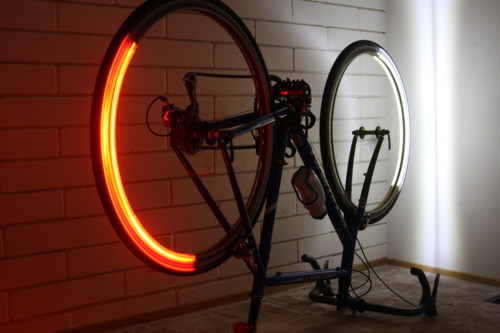
The first is Revolights. Revolights consist of 2 thin profile LED rings (white in front, red in back) that mount directly to each wheel rim (just below the brake calipers) using a series of rim specific clips. Power is supplied via a thin wire to the hub where a lightweight and slim, USB rechargeable polymer lithium-ion battery is held in a special bracket. A small magnet is secured to the fork to provide speed and orientation information to the rings.


They are on prototype design version 4. V4 currently demonstrates all of the critical functions: it is simple to install, does not interfere with the ride, and is fully functioning. But further design elements need to be tested to get it to a production ready status; i.e. to a place where it can be used by everyone. This involves construction of a 5th, possibly 6th, prototype version in quantities that will allow testers to assure the lights are ready for prime time.

On the road, bike lights contribute to rider safety in two ways:
1) lighting - allows riders to safely navigate at night by illuminating their forward path.
2) sighting - increases the rider's front, back, and side visibility which signals their presence (i.e. i am a bike) and location to those sharing the road.


In 2008: The two most frequent causes for the 52,000 reported bicycle accidents are collisions with motor vehicles (58%) and individual falls (30%). Of the 716 reported fatalities, 69% occurred in urban areas and 39% were between the hours of 5 p.m. and midnight. Nearly 70% of all nighttime Bicycle-Car collisions are due to inadequate side visibility.

Gizmag has additional pics and info. The Revolights inventor and two partners are trying to raise money to take the idea to market via Kickstarter. As of this writing, he has more than $26,000 pledged toward a $43,500 goal. Who wants one? $220 is the expected price.


Project Aura: Bicycle Safety Lighting System from Project AURA on Vimeo.

The second light of note is the Aura system. Again, if you're tired of regular bike lights, check out these two ideas for illuminating your bike on the road, via the rims. Not only do they look cool, they allow you to be seen from the side, instead of just the front and back with traditional bike lights. Safe and sharp at the same time.

According to Gizmag: Aura comes from two industrial design sophomores at Carnegie Mellon University in Pittsburgh, using six groups of three tri-color LEDs powered by a dynamo generator. The design won an international Core77 award for helping address the issue of nightime bicycling accidents.

An increase in bicycle lighting and sighting has the potential to reduce rider injuries and fatalities. It's time to provide rider's with a single bike light solution that allows them to safely experience the joy of riding, regardless of the time of day.

Tuesday, August 16, 2011

Seville Shows Proof In Their Success

Seville
In my daily perusing of the internet, I came across an article about the city of Seville, Spain. I didn't know anything about  the city, but saw that Seville hosted the annual international cycling planning conference, Velo City, which is organized by the European Cyclists Federation, this past March.

Apparently Seville is a perfect example, if any proof is needed, that if you build a cycle infrastructure, people will get on their bikes and cycle. The city went from a very basic starting point in 2006, the city built a full cycle track system that has seen the number of cyclists rise from 6,000 to 600,000 in four years. Seville’s local metropolitan authority estimates that that 6.6% of all journeys in the city are now made by bikes.

Under The Steering Plan for Bicycles (2007-2010), Seville has constructed 120 kilometers of segregated cycle tracks, up from the no cycle tracks at all. A public bicycle hire system has also been created in that time. Called Sevici, and based on Paris’ bike hire system, there are over 2,500 bicycles available which can be collected from 250 points over the city.

The rapid transformation of Seville to a city with a now ingrained cycle culture must become the point of reference to show that if investment is made than cities can become cycle friendly. So if Seville can do it, everybody can do it.

Monday, August 15, 2011

Bogota's Bikeways Are Awesome


Riding Bogota's Bountiful Protected Bikeways from Streetfilms on Vimeo.

This is another awesome video by Streetfilms  It is not only great because it shows us a powerful example of bike infrastructure improving a city, but also because it shows how you can change the perception of riding a bike among citizens by treating bikes as an equally important way to get around and building safe lanes in both poor and rich neighborhoods.
"When we build very high quality bicycle infrastructure, besides protecting cyclists, it shows that a citizen on a $30 bicycle is equally as important to one in a $30,000 car," said former mayor Enrique PeƱalosa.

Monday, August 8, 2011

Bike Sharing Makes You Fit and Helps Save the Environment

It's no longer big news when a European city gets a new bike share program, unless they do it bigger, better, or with a technical innovation that hasn't been seen before. It is newsworthy, however, that data is starting to trickle in - in this case, from Barcelona - indicating how beneficial bike sharing is to city residents. Just like regular city biking, bike sharing makes urban residents fitter and drops our greenhouse gas emissions, says a study published in the British Medical Journal. Those reduced greenhouse gas emissions and improvements to cyclist health far outweigh the risks from increased exposure to traffic and traffic's polluting byproducts.

Researchers compared a car's occupants tootling around Barcelona's beautiful paseos with a cyclist traversing the bike lanes on the highly successful Bicing bike share. (Bicing has increased cycle trips in Barcelona by 30%, where the average increase is about 3%.)

The results were given statistically: bike share users did have an increased mortality rate of 0.03 from crashes and of 0.13 from increased exposure to air pollution. The increase in physical activity from biking with the Bici bikes, however, resulted in 12.46 fewer deaths when compared with the car drivers.

In addition, Bicing has resulted in a reduction in annual carbon dioxide emissions in the region by 9 million kilograms. Which is about 1% of Barcelona's annual carbon emissions from all road vehicles.

The researchers used a health impact assessment to compare how car travel impacts city residents to how Bici travel does. They took their data pool from only regular Bicing users, and assumed that 90% of those had only started regular cycle commuting after Bicing came into being. The plus of this was that the study was able to measure differences more easily than if they had studied a group of regular commuter cyclists who simply joined Bicing when it started up instead of using their own bikes. The downside is that there's no way to know if that assumption is accurate.

The researchers also used Bicing's own data as far as length of trips and reasons for using the bike share - 68% of trips used for commuting to work or school and 37% combined with another mode of travel. The mean distance traveled by Bicing on a working day is 3.29 kilometers.

The researchers say that Bicing saves around 12.46 lives per year in the Barcelona population, and that this positive result is corroborated by two different studies - a Dutch study that showed the benefits of cycling "substantially" outweigh the risks in the Netherlands, and a 2009 study published in the Lancet that showed very real public health benefits in the UK and India by reducing emissions and encouraging active transportation.

Though the study's authors concede the study is limited by the "availability of data and the necessity to make assumptions to model likely scenarios," they carried out sensitivity analysis to assess the results, and also found that in all scenarios tested there was a net benefit (i.e. increased longevity) for Bicing users.

Wednesday, August 3, 2011

Slow Biking: Not Everyone Is In A Race

slow bike photo


slow bike new york photoMost cyclist have heard about or know about "Copenhagenizing", Mikael Colville-Anderson's term for learning to ride bikes like they do in Copenhagen, in street clothes, at a comfortable pace, usually without a helmet. Andrew Sullivan points us to the American version, where it has become part of the Slow Movement, and is now called Slow Biking, since a slow car movement has never caught on.

Celeste LeCompte makes some suggestions for Slow Biking in the San Francisco Chronicle:
-Choose a bike that lets you keep an upright posture. Racing-style road bikes encourage the rider to lean forward, while step-throughs, cruisers and mixte frame bikes are more upright. -- Look for fashion-protecting features. Keep your ride comfy and your clothes clean with good fenders, chain guards or internal hubs, flat pedals and maybe even a kickstand.
-- Go for gears. You're not looking for a lot, but more gears gives you more options when you're tackling San Francisco's hilly terrain at a more casual speed.
-- Ride safely. Even though you're riding slowly, don't forgo the helmet, stop at traffic signals and ride predictably.
-- Share the road. When you're riding slowly, it's easier to double up in the roadways and chat with a fellow rider. Bring a friend and enjoy the time to catch up.
slow bike new york bike lane photoI would also point out that slow biking is a lot safer. I typically ride a road bike and it is harder to go slow, but my wife's commuter is a "slow ride". She rides a 3-speed Trek Belleville that is relatively slower than conventional bikes, but she finds that she can dodge pedestrians and brake for opening doors a lot more easily than she would on a conventional bike.


Felix Salmon picks up the story at Reuters, and suggests that everyone should just slow down:
As a general rule, the propensity of non-bicyclists to give biking a try is inversely proportional to the average velocity of the bikers they see on the street. If you live in a city where women in wedge heels are steering their old steel bikes around their daily errand route, there's really nothing intimidating or scary about the prospect of getting on a bike yourself. If it's all hipsters on fixies, by contrast, that just makes biking feel all the more alien and stupid.

So, next time you get on a bike, give yourself an extra five or ten minutes, and take your time. You'll be much happier for doing so. And your happiness is likely to prove contagious.
While I agree with Felix about slowing down, I don't share his criticism of hipsters on fixies; I find that generally they would fall into the slow biking movement. It is more the jerks on probably stolen mountain mountain bikes, like the one I saw riding on the sidewalk yesterday, almost taking out a walking hipster, that are the real problem.

Tuesday, August 2, 2011

London's Boris Bikes Turn One Year Old

bike serp photo

It has been interesting blogging about cycling progress and seeing things blossom into successful systems. The Boris Bikes, or Barclays Cycle Hire, the official name, turns 1-year old this week. It's been a year since the rental bicycle system was introduced to London, and cyclists have taken to it with a passion.bike mash photoWith 6 million journeys to date, they have captured the public imagination. Despite fears, only 200 of the 6,000 bikes have had to be scrapped due to vandalism and there have been no serious injuries reported.

In fact it has been such a success that an extension to the network has just been announced: to parts of the east, west and south of the city. A total of 4,200 docking points and 2,000 new bikes will be introduced by 2013.

Barclays have increased their sponsorship by an additional £25 million, and extended their deal to 2018. Although many have deplored the commercialization of the scheme, even with this influx of money the rental scheme is expected to lose £10 million in its first year, and is unlikely to break even any time soon.

As for wear and tear, 100 Boris bikes need to be repaired every day. However, with 20,000 trips made a day, this isn't too bad. The operator has a team of 15 mechanics patching them up. It would seem that most damage is due to the increase in casual users who are not so cycle-wise.

bike lorn photoIt's not perfect: the docking stations are often full so cyclists have to keep driving around until they find an open one to park their bikes. Docking stations can be empty in the morning when there is a rush of commuters and at some busier stations they should be many more bicycles available. One report found that the users are mainly white men between 25 and 44 years old, many earning more than £50,000 a year.
However, anecdotal reports indicate that many people end up buying a bicycle because of their positive experiences on the Boris bike.

London Transport has issued some interesting facts and figures about the first year.

There are 128,803 members, as opposed to casual users. They use 81,060 bicycles during the week and 17,311 on weekends. They represent 84% of the rentals and 16% by casual users. The average journey time for weekday trips is 16 minutes (the first half hour is free) and on the weekend, average time is 23 minutes.

Monday, August 1, 2011

Miami Critical Mass is Getting Huge!

I have experienced a few great Critical Mass rides. My personal top 3 would be Paris France, San Francisco, and New York City, but if Miami keeps it, they may be taking 3rd.

This past Friday when cities all over the world had their monthly Critical Mass ride, and Miami was sporting over 800 riders. As you can see in the videos below, the riders are full of energy and celebrating the bicycle, and they take over 6 minutes to go by! The Bike Miami Scene has done a great job of promoting Critical Mass and has listed out their purpose, rules of the ride, and have used media to get the word out. Good on you.


Transportation for America Coalition