Tuesday, June 7, 2011

Ray LaHood Bikes to Work


Ray LaHood Bikes to Work from Jay Mallin on Vimeo.

JFM_0672e
Monday morning a friend of mine biked to work with a group of DOT commuters from the Washington Monument to DOT's headquarters building.  The route was safe and well-marked; they enjoyed some exercise; and they didn't burn a drop of gas--which saved money. That's what I call a successful commute.
JFM_0613e

President Obama understands that high gas prices are pinching family budgets across America.  And it is good to see that DOT is committed to providing people with convenient, affordable, and healthy transportation options.

That can help ease the pain everyone feels at the pump these days.  It can lower the burden of tailpipe emissions on our environment.  And it can create economic opportunities.  We know that building bicycle, transit, and rail facilities creates jobs.  And we know that businesses will pop up where streets are friendly to bicyclists and pedestrians.
_JFK8162

_JFK8132


Finally people can commute by bike in Washington, DC, because this city has worked hard to make it easier and safer for people to use their bicycles--not just for recreation, but for transportation.  Washington has become a bike-friendly city.

The League of American Bicyclists recently recognized the city's efforts with its Silver award.  In fact, there's an informal race on the East Coast to see which large city can be first to achieve the Gold award. When we have cities competing to be acknowledged for their livability, that tells me things are going in the right direction.

The U.S. Department of Transportation has played its part in DC's bike-volution. For example, they helped fund development of Capital Bikeshare, a program that makes more than 1,100 bikes available to its members throughout DC and Arlington. People can hop on a bike at one station and drop it at another. With 110 stations at transit stops, grocery stores, office buildings, and more, it's a very convenient way to get around.

In May 2010, DOT bicycle commuters were given a new benefit that allows reimbursement for qualified commuting costs similar to that provided to employees who commute by public transportation.
Around the nation, USDOT is working hard to help state DOTs and communities integrate the needs of bicyclists and pedestrians in road projects.  And through their TIGER program, they have funded major projects that allow Americans to safely and conveniently get where they need to go on a bike or on foot. This shows the country that DOT is out there continuing to lead in helping Americans use whatever methods of transportation they can to get where people need to go.  Plus, it was a lot of fun.

Monday, June 6, 2011

Chicago Gets First Protected Cycle Track

There is good news for cyclists coming out of Chicago today. A half-mile stretch of Kinzie Street between Milwaukee Avenue and Wells Street will be used to test out the city's first protected bike lanes.

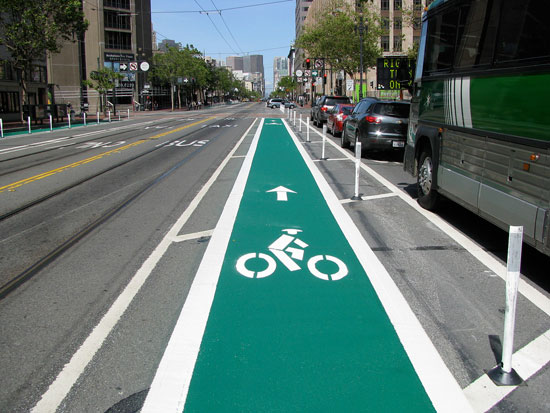
42nd Ward Ald. Brendan Reilly announced the pilot program in his newsletter Friday. The cycle track, places all motorized traffic to the left of the cyclist, with the lane protected either via a construction barrier (like these), a raised median or other divider; the Kinzie pilot program will use flexible posts.

The program is being funded by a $3.2 million federal grant awarded to the Chicago Department of Transportation, who were originally going to test the program on a stretch of South Stony Island Avenue where bicycle traffic is infrequent before switching to Kinzie.


Bicycle transportation advocate Steven Vance is cautiously optimistic about the location. Others think it's a bad idea to place the cycle track in an area they feel won't attract new cyclists and, given some of the inclines along the route, may lead to a logjam of cyclists at points.


By looking at it on Google Earth, I'd be more inclined to see it in an area that sees some serious bike traffic, like the intersection of Grand, Milwaukee and Halsted. Or maybe near the area of Wicker Park where the city will get its first designated Bike parking area. Regardless, it's a start and I am optimistic to see the results. It could be the beginning of making Chicago even more bike-friendly, coupled with legislation awaiting Gov. Quinn's signature that will allow bicyclists and motorcycles to make "slow stops" at red lights and stop signs.

Thursday, June 2, 2011

Hangzhou Cina's Bike-Share


File this one in the category: "Learning from China". Hangzhou's bike-sharing system is an inspiration for the rest of the world. The fundamentals aren't so different from what is being done elsewhere (like Vélib in Paris), but the ambition is on another scale. The Hangzhou Public Bicycles are well integrated into the other mass transit modes, the number of bikes and stations is growing very rapidly, and the bikes are essentially free on most trips.They currently provide 2,000+ Stations, 50,000+ Bicycles Now, and 175,000+ Expected by 2020. Check out the video above to see just how great the system is and how satisfied local residents are. Via Streetfilms.

Tuesday, May 31, 2011

Breeze Launches in Britain to Increase Women Ridership

DarlingtonBeautiesAndBikes.jpg
While in the U.S. the bike revolution is happening, women of all ages and children under 18 aren't equal participants. In fact in the U.S. (aside from pockets like Portland, San Francisco, New York, etc.) the number of women riders is barely holding steady, while the number of kids riding bikes is dropping. In the U.K. however, in 2010 women made up a decent 40% of of all journeys on the country's national cycling network. That's a 13% increase in women riding on the network from 2009's figures. How did they do it?

Well, the National Cycle Network (NCN) assumes that high gas prices had something to do with the exodus of drivers from their cars and on to the bike path. A "whopping" 420 million journeys were made on the country's network of cycle paths in 2010, and of those, approximately one quarter are estimated to be work commute trips.

The NCN carefully totted up the cost savings of all this cycling - stating that the walking and biking commuters saved £46 million in at the pump, and with a potential greenhouse gas savings of 657,000 tons.
However, while ridership and bike commuting among women is increasing, the overall gap between men who cycle and women who cycle is still wide. Overall, British male cyclists outnumber British female cyclists 3 to 1 (similar to U.S. figures).

And UK research suggests there are a million British women that would like to bike more often. Last week British Cycling launched a national network of rides called Breeze, and intends to introduce 80,00 additional women to the joys of cycling.

The effort is funded by the National Lottery. Breeze rides will be short, traffic-free, and casual rides aimed at working mothers and women who haven't been on their bikes in a while. British Cycling's survey of 1,000 women showed that safety concerns (sound familiar?), unfamiliarity of cycle routes, and having no one to cycle with were the three reasons they didn't do so.

British Cycling intends to train a network of female cyclists who will lead Breeze rides. Via the rides and support, the Breeze program hopes to convert 20,000 of the 80,000 women estimated to participate in rides this summer to "regular cyclists." Sounds awesome to me.

Monday, May 30, 2011

Trip to California


Sorry for the lag in posts, but I just returned from a trip to California. We had a great trip from San Diego to San Francisco. It is pretty awesome to see all of the progress that the state of California has made in their transportation choices. Especially in their correction of many of their poor choices in the past, and focusing more on complete street designs.

We started out in San Diego and southern California and the first thing that I noticed, which I have seen before out west but had forgotten until I experienced it again, was the priority that pedestrians and cyclists receive from motorists. If a pedestrian steps off of the curb, even without a walk signal, the cars automatically stop to let the people cross. I realize that is the way that it is supposed to be, but it is truly practiced out west and it goes for cyclists too. Riders were given plenty of room as vehicles passed them, and they facilities that have been provided has made it easy to get around by bike.

We went to a stage of the Tour of California while we were there, and that too helped me see the great culture that they have for cycling. Not only do many of the people out there cycle for commuting and recreation, but they also care about advocacy and making cycling better. I was also surprised when I would mention that I was from Florida, and many of the people would actually apologized and ask me if the drivers were as bad as they had heard or experienced. It was definitely unexpected and unfortunate that Florida's reputation precedes itself.

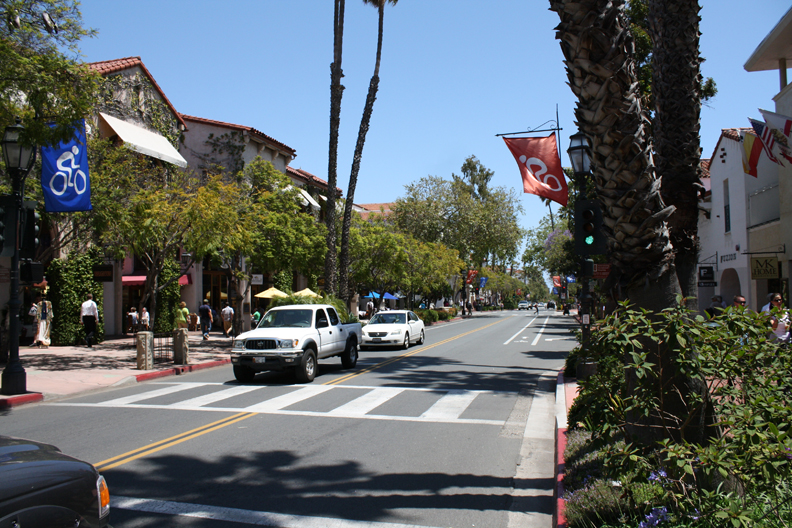
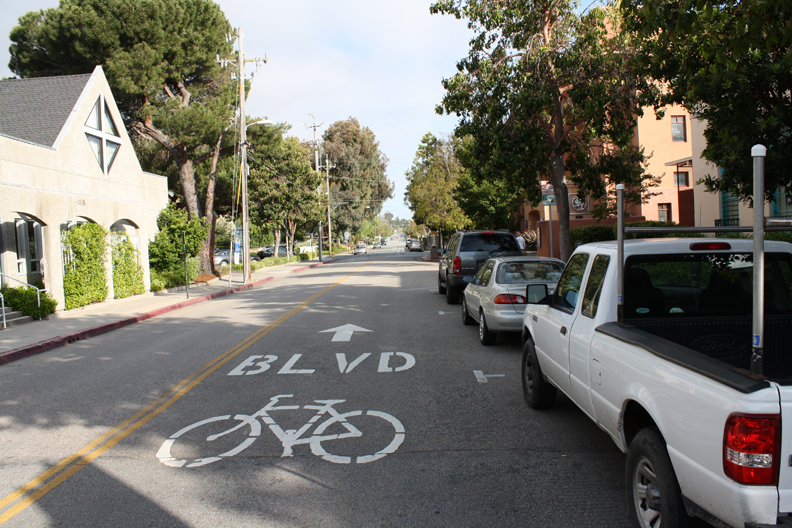
Fortunately I was able to visit several of the communities and small towns and was able to see how great their cycling environment is. Every town had new bike lanes, bike corral parking, and bike route signage. Cities like LA and San Francisco has made the jump into infrastructure with advanced separated bike lanes, bike boxes, and connecting all of their public transportation systems with bikes. Even though while I was there the temperatures were chilly and the weather was wet and dreary, the cyclists were out in full force. I could see where San Francisco could rival places like New York, Portland, Seattle, and Austin with the per capita ridership. Their critical mass was even escorted by police, which to me not only shows that the police are with the cyclists, but that the city embraces cycling and has all of their priorities invested in creating a great place to ride.

Monday, May 16, 2011

Planning with Bicycle Oriented Deisgn

I get several articles sent my way every week from other advocates and colleagues at work. I received an interesting article this past weekend that Nick Martens wrote in 2008 "The Problem of Biking in America," published in the online magazine The Bygone Bureau.

"Of the many complaints an American cyclist can make, a concern over his or her safety is the most serious. It is also the best reason to stick with a car." 

In the article, Martens describes the common problem of a motorist unexpectedly opening a car door in the path of a cyclist properly staying in the bike lane on the right side of the street. Without question, fear of bike-auto collisions is among the most pervasive factors limiting bike use for U.S. commuting trips. In the United States, the driver-side door opens into the bike lane; in European streets designed for bikes it does not.


I have found that many factors seem to limit urban biking in the United States. For those older than 25, fear of losing in an encounter with a speeding car is probably the most important reason, with adverse weather being another. Relatively few of those who bike to work do so every day; bad weather requires a backup plan. Lack of convenient bike storage is common in city apartments, and there is a justifiable fear of theft. Commuting in America for so long has meant single-occupancy cars that the mindset is doubtlessly hard to break. Americans have grown accustomed to the $8,000 annual cost of auto ownership (including depreciation), so saving money by cycling is a less pressing concern. Plus, American streets have been designed and refined to facilitate automobile traffic at speeds of 30 miles per hour or more—and are less safe for bike traffic.

Freedom from Fear
In the Netherlands, the degree to which the safety of bikers is protected varies with development density. Outside city limits, some roads are marked for bike lanes, but many have no indication of where biking is encouraged. In cities, however, the Dutch have invested heavily in dedicated bike lanes with special safety controls—essentially a separate set of red, yellow, and green lights for cyclists. The most elaborate arrangement of roadways includes areas designated for four different means of transit. Those designations are:
  • the center lane, for cars, trucks, trams, and buses.
  • the next lane, for auto parking; the driver’s door does not open toward bikers.
  • the bike lane.
  • the lane next to the buildings, for pedestrians: the sidewalk.
The ability to make streets multimodal and widely used by bike commuters depends on the degree to which the dedicated lanes are made reassuring to potential users. To produce comfortable conditions for bikers requires clarity: what are the rules? how should bikers and drivers behave? what is our turf and what is theirs? Ambiguity breeds uncertainty, which in turn contributes to accidents and discourages potential bikers. Where European bicycle traffic is greatest, investments in clarity are most apparent. Clarity factors include separate, protected lanes; traffic signals dedicated to cyclists; and obvious signs signaling where bikes may go and where they should not.

The broad popularity of biking in dense European cities at peak periods has resulted from the infrastructure investments that produce a comfort level almost unimaginable in the United States. Gray-haired women pedal to go shopping; parents move their preschool children by bike through downtown traffic. On a scale of one to ten evaluating biker concern about possible injuries, conditions witnessed in northern Europe would generally rate an eight or nine, while U.S. cities would rate a two.

Prospects for American Conversion
Those who advocate planning for expanded U.S. use of bikes frequently cite improved health or expanded recreation, mixing these desirable goals with the most salient of the European gains, those related to bikes as urban transportation. Occasional recreational use will not contribute significantly to cleaner air, less-congested streets, or wider use of public transit.

Martens noted the political impasse associated with encouraging public investment in bike- friendly U.S. cities when there is so little daily biking occurring—a condition in large measure attributable to the lack of bike-friendly conditions. American bikers are predominantly young, male, and urban—not a powerful constituency. Most Americans are car owners, happy with that condition, and sometimes antagonistic to bikers.

Any jurisdiction contemplating a serious modification of streets to reduce fear of cyclist injuries and expand use of bikes for commuting and shopping should study the results in Copenhagen. Important options have already been tested there. Starting with specified goals would help planners avoid some expensive missteps. Copenhagen, for example, seeks to increase the share of bikers who feel comfortable or secure when biking to 80 percent, and is well along toward that goal.

The shift from cars to bikes in Europe can be traced to the steady, persistent, decades-long pace followed by governments there in adapting streets to create bike-friendly transportation routes. A cheap effort will not do it. An inexpensive stripe next to a parking lane does not produce comfortable biking conditions; in many cases it is a recipe for collisions with car doors. It is hard to imagine U.S. cities committing to two or three decades of block-by-block reconstruction and continued bike-oriented education and rule enforcement. Opposition could be expected to proposals to move car parking toward the center of the street and install special traffic controls and curbs designed to protect bikers.

Also, there are stronger competitors for America’s infrastructure funding. The highway lobby has a 50-year lock on gasoline tax revenues. Other claimants—subways, buses, and commuter rail—may receive a larger share of these funds as the country tries to cut petroleum dependency. There is also the newly recognized need to repair and upgrade thousands of bridges and tunnels that elected officials pray will not collapse on their watch.

Probably the best prospects for financing conversions would follow use of appropriations for a larger public cause, such as reducing global warming or employing jobless workers. Two or three good examples in American cities might influence others. New York City is modifying some streets to favor biking. Philadelphia might create a bike connection linking the convention center, seven museums, and the Schuylkill River trail, connecting Drexel and Pennsylvania universities with existing bikeways reaching Norristown and beyond—more a recreational than a transportation benefit, but it would produce substantially more people on two wheels than at present. Broad Street and Market Street may be wide enough for bike lane protection, with some loss of curb and delivery parking. Requiring bike storage facilities in new residential buildings and fewer car parking spaces would help. A gasoline price of $10 per gallon would boost bike use, but do little for the comfort level in peak-hour traffic.

In a nation attuned to quick and cheap solutions, the widespread replacement of cars by bikes as accomplished in European cities will be seen as a long-range and expensive objective.

Friday, May 13, 2011

Bikes Make Life Better


One thing we all know as riders it's this: bikes make life better. Bikes keep us healthy and happy, and fill our lives with adventure and excitement.
In honor of National Bike Month, People For Bikes created a short film that celebrates what we all love: bikes. Their video shows not only the ways that bikes transform the lives of people who ride them, but also how they help change and beautify the communities we call home.
Check it out and share it with your friends. Don't forget to ask them to take the peopleforbikes.org pledge. Every name gets us closer to more bike lanes, paths and trails - a better world for all who ride.

Check out how they made the video below.
Transportation for America Coalition