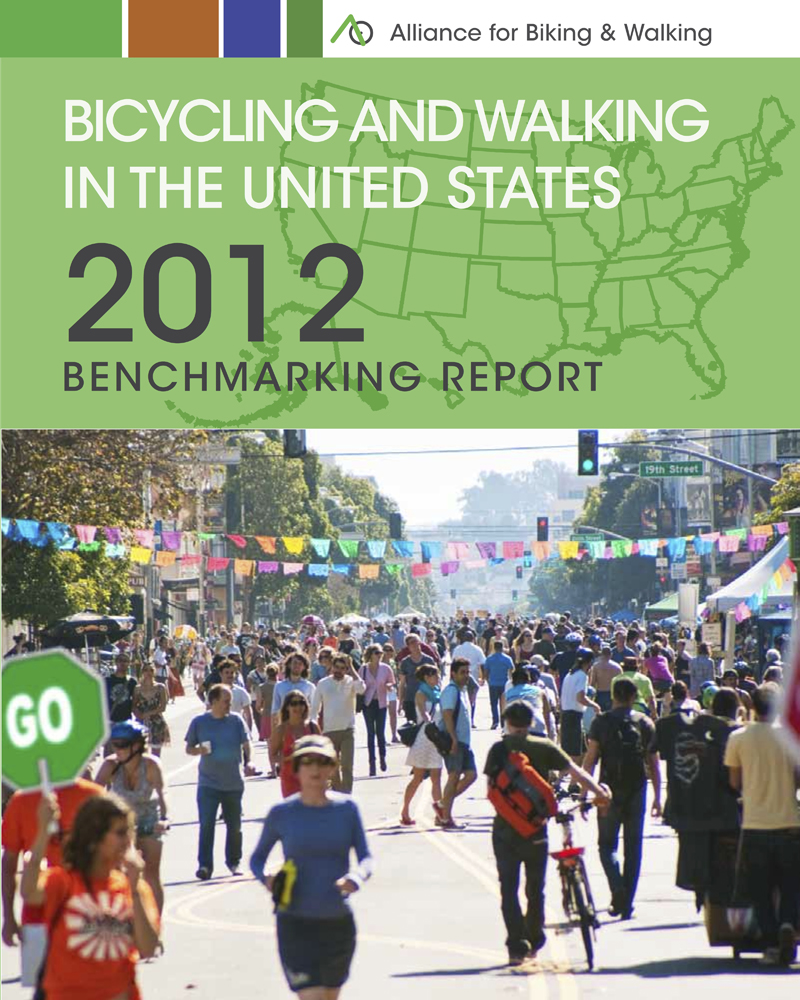
The Alliance for Biking and Walking just released its
biannual benchmark report,
and the results may surprise you. The state with the greatest
percentage of cyclists and walkers? Alaska. Among cities, Boston takes
the crown.
If those results seem a little bit off—Isn’t Portland the country’s biking mecca? Or, if you trust
Bicycling Magazine,
Minneapolis?—consider
another figure from the Alliance’s report: Americans choose to walk for
10.5 percent of all their trips, and bike just 1 percent of the time.
While Bostonians aren’t known for their bike culture, 13.9 percent
of the city’s commuters walk to work.

“All those cities we have at the top of the list, they were all cities
that were built around human beings first,” says Alliance president
Jeffrey Miller. These cities have grids, or in the case of Boston, a web
of streets designed for pedestrians that tend to make drivers crazy.
“It’s easier to walk and bike in parts of these cities than to drive,”
Miller says.
And Alaska? “We know that people will vote with
their wallet,” he says. “Gasoline is like $10 a gallon there. It's
expensive to drive.”
The Alliance’s benchmark report does
confirm deeply held notions about America’s bike revolution. Of the
country’s 50 largest cities (plus New Orleans), Portland is home to the
greatest percentage of people commuting to work by bike. It’s also the
only city listed in which more commuters choose to bike than choose to
walk. But the report also shows that while bike culture might be
booming, most people who choose to get around without cars still hoof
it. Given the importance of walking to car-free living, the cities that
best represent an alternative vision of the country’s transportation
future may not be Portland or Boston, but Washington, D.C.,
San Francisco, and Seattle—all of which rank highly for both biking and
walking and which hold the number two, three, and four slots on the
combined list.
There are several similarities that make those three cities successful: All three have "
complete streets"
policies; D.C.'s took effect in the past couple of years. They all fine
drivers for not yielding to bikes and have bike-parking requirements in
new buildings. D.C. and San Francisco also require bike parking in
buildings or garages, while San Francisco requires it at public events.
San Francisco has more miles of bike lanes, multi-use paths and signed
bike routes per square mile than any other city in the country; Seattle
and San Francisco have innovative bike infrastructure, like shared lane
markings, home zones, colored bike lanes, bike boxes, contra flow bike
lanes, and bike traffic lights. D.C. has some, but not all, of those
features, plus cycle tracks, which are physically separated from car
traffic but still on the road.
“What it seems we need is for communities to engage as many options as they can to encourage biking and walking,” Miller says.

Cities and states are doing something right: the Alliance found that
Americans make 12 percent of all trips by foot or bike despite the fact
that these transportation modes receive just 1.6 percent of federal
transportation dollars. And cities across the country are moving toward
ever-bigger infrastructure projects, particularly for biking: The list
of planned bike facilities shows that Nashville will have more than 850
additional miles of bike infrastructure by 2027; Los Angeles will have
added more than 1,600 miles by 2041; by 2032, New Orleans will have an
additional 1,002 miles of bike facilities and New York an additional
1,800 miles.

 10,000 new bikes will appear in New York City next summer when the new
bike-sharing program is launched. The bikes will be located in 600
stations sprinkled around Manhattan and Brooklyn, but the exact location
of each station still needs to be determined. That's where citizens of
NYC come in! The NYC Department of Transportation (DOT) will be holding community planning workshops
in various areas of the city to allow local citizens to help determine
what the best spots are for stations, and what the "hell no" locations
are.
10,000 new bikes will appear in New York City next summer when the new
bike-sharing program is launched. The bikes will be located in 600
stations sprinkled around Manhattan and Brooklyn, but the exact location
of each station still needs to be determined. That's where citizens of
NYC come in! The NYC Department of Transportation (DOT) will be holding community planning workshops
in various areas of the city to allow local citizens to help determine
what the best spots are for stations, and what the "hell no" locations
are.

 Beyond bikes, music, and home brewing, politics is my other big hobby. So like most political junkies, I was glued to my TV last night to see the President's State of the Union. When the president of the executive branch of the U.S. government talks
about something, it gets on a lot of people's radar. It doesn't mean
that things will immediately start happening, but it does give
legitimacy to any issue. That's why my biggest wish for this speech was for bikes and bike infrastructure to be mentioned.
Beyond bikes, music, and home brewing, politics is my other big hobby. So like most political junkies, I was glued to my TV last night to see the President's State of the Union. When the president of the executive branch of the U.S. government talks
about something, it gets on a lot of people's radar. It doesn't mean
that things will immediately start happening, but it does give
legitimacy to any issue. That's why my biggest wish for this speech was for bikes and bike infrastructure to be mentioned. I understand that protected bike lanes, bike boulevards, bike parkings, etc, are more of a city issue. But the federal government can still play a big role (Transportation Secretary Ray LaHood
has taken many steps in the right direction), both in setting a
national agenda and by creating broad incentives that will encourage
cities and states to do more and do it faster.
I understand that protected bike lanes, bike boulevards, bike parkings, etc, are more of a city issue. But the federal government can still play a big role (Transportation Secretary Ray LaHood
has taken many steps in the right direction), both in setting a
national agenda and by creating broad incentives that will encourage
cities and states to do more and do it faster. So
how about it, Mr. President? Are you looking for a relatively cheap way
to improve the U.S. infrastructure base? To improve public health,
quality of life in cities, reduce air pollution and oil imports? Save
money by reducing wear & tear on roads and reducing lost
productivity due to congestion?
So
how about it, Mr. President? Are you looking for a relatively cheap way
to improve the U.S. infrastructure base? To improve public health,
quality of life in cities, reduce air pollution and oil imports? Save
money by reducing wear & tear on roads and reducing lost
productivity due to congestion?


 Posts
Posts


