Wednesday, April 27, 2011

Oregon College Pays Students to Ride Bikes

Portland Cyclist on the Burnside Bridge photo

As a blogger about biking, I'm always mentally searching for what gets people to ride. Is it fashion, cool bikes, or tons of infrastructure? For me, the secret was huge savings in gas and vehicle costs, extra physical activity, and the simple realization that no matter the weather (and Florida's weather can get pretty warm) I feel better biking.

However, in Portland, one organization realized that money may speak louder than any words that a blogger can raise. Bike Portland reports on Oregon Health Science University (OHSU) going one better - giving students (and faculty) up to 50 dollars a month for riding their bikes.

Of course, the Bicycle Commuter Act lets employers provide a $20 monthly incentive to employee cyclists. OHSU's web-based system for logging rides to and from the university is for students, too, however, and thus is not quite the same. Anyone already with a parking pass program will get refunded one month's parking for 30 bike trips. Those with subsidized transit passes get a free month's pass for thirty trips, while those with neither of the above will get $50 dollars each month they log those thirty trips.

The program does have some caveats - the participant must be a OHSU "badge holder" and log trips of more than two miles. The school has more than doubled the payments to cycling commuters since 2008, and will pay out nearly $200,000 by mid-year this year.

How can the school justify that kind of money to bicyclists? Cycling commuters create less strain on parking resources - at some lots on the campus there can be a months' long wait for a car parking pass. OHSU's parking problem is not just a headache, however - the school must find ways to curb its appetite for parking spaces or face limits to future expansion. That's its internal incentive to having the program.

Always rising health care costs are another justification. More than 1,200 people - that's more than 10% of the OHSU population - are enrolled in the program. In spite of the success, OHSU isn't projecting that ridership will climb much beyond 10% at this time. Higher gas prices could change that.

The program does raise a question. If OHSU needed an incentive to create a program that pays a small but welcome cash incentive to cyclists, how do we create or recreate that carrot or stick at other companies and entities so that they will do something similar?

Tuesday, April 26, 2011

Moving Beyond the Automobile-Parking Reform


In the tenth and final video in Streetfilms' Moving Beyond the Automobile series, they are talking about parking reform. From doing away with mandatory parking minimums, to charging the right price for curbside parking, to converting on-street parking spots into parklets and bike corrals, cities are latching onto exciting new ideas to make more room for people in our cities and repurpose the valuable public space that lines our streets.
"Historically the parking problem was defined as there not being enough convenient places to put your car," UPenn professor Rachel Weinberger told Streetfilms, "but increasingly cities are starting to understand that the parking problem could be defined differently and it could be the case that there is too much parking."

Moving Beyond the Automobile-Correct Price of Parking


Yet another great installment in the "Moving Beyond the Automobile" series from our friends at Streetfilms. This episode explores the problems caused by under-priced parking spots in cities; how some of the most valuable land in the world is almost given away, meaning that free spots are hard to find and a large fraction of the traffic is cars cruising around, looking for a spot, polluting the air and emitting CO2... But there are ways to fix that, as the video above shows. Via Streetfilms.

Wednesday, April 20, 2011

Protected Bike Lanes are on the Way

I have been in Portland Oregon this week and it is an amazing place to say the least. The state of Oregon implemented policies that mandate and street that recieves improvements, to have to include multi-modal facilities, typically bicycle lanes. They are everywhere here, and have started to take on new designs as they adapt to their context and are influenced by higher ridership.

One of the new kids on the block have a euro feel and several names: Cycle Tracks, Protected Bike Lanes, Bike Paths. Bottom line is, most people won’t start riding until you take cars out of the equation. Why? Because even well-intentioned people do stupid or careless things, and when people do stupid or careless things while in a car, they could hurt or kill others. Even a cyclist’s own mistake can put them at much greater risk when riding alongside traffic.

So we have the classic chicken and the egg problem – you have to build great facilities first, then the people will ride. Current bike lane designs are ripe for abuse. There’s no way that police departments anywhere in cities will ever be able to effectively police bike lane misuse. In some cases, police themselves use them as parking lanes. Needless to mention, bike lanes also fail at protecting the cyclist. Visual proof follows.


Simple solution to avoiding all of the above:

Completely take cyclists out of harm’s way.

Dennis Hindman hits it right on the head with his comments on the “BPIT Top 10” LADOT Bike Blog article. It makes the case for the need of a “perceived barrier” that physically separates and protects cyclists from car traffic.  As a buffer, use planters, landscaping, bollards, or a row of parked cars.  You know, “experimental” stuff that most people would consider a no brainer. Vancouver gets it, Montreal gets it. 

Below are some of the American examples that have popped up and are already wrorking at increasing ridership and safety.

The "controversial" Prospect Park West bike lane, NYC


Wednesday, April 13, 2011

Moving Beyond the Automobile-Road Diets


What’s a road diet? Quite simply, traffic-calming expert Dan Burden responds , “A road diet is anytime you take any lane out of a road.”

The first time people hear about a road diet, their initial reaction likely goes something like this: “How can removing lanes improve my neighborhood and not cause traffic backups?” It seems counter-intuitive, but taking away lanes can actually help traffic flow smoother while improving safety for everyone.

Road diets are good for pedestrians: They reduce speeding and make vehicle movements more predictable while shortening crossing distances, usually through curb extensions or center median islands. They’re good for cyclists: Many road diets shift space from car lanes to create bike lanes. They’re good for drivers: Less speeding improves safety for motorists and passengers, and providing left-turn pockets allows through traffic to proceed without shifting lanes or waiting behind turning vehicles.

And here’s something to keep in mind during this era of lean budgets: Road diets are a highly-effective infrastructure improvement that can be implemented quickly and at low cost.

Monday, April 11, 2011

New Design for Bike Racks on the Sides of Buildings

Bike parking in most big cities is a tough battle for available, usable space. There's never enough of it for the simple reason that parking (especially the good kind, like sheds) hogs precious real estate that dense regions either don't have or can't afford to cede. One architect's solution: Stash bikes in something cities have in abundance -- the air.
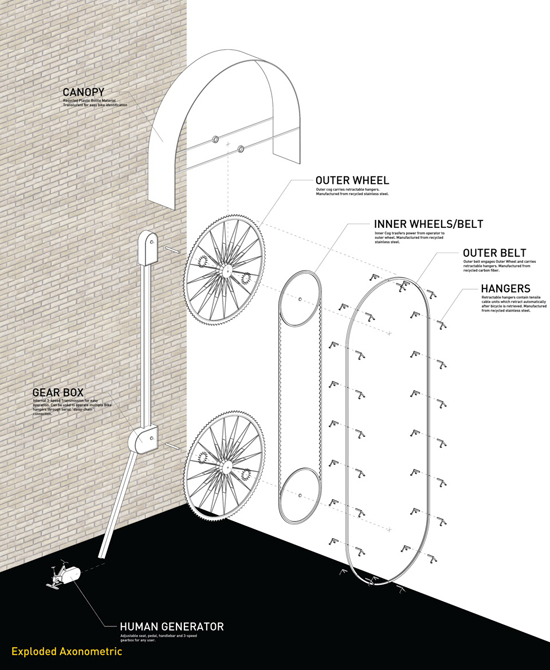
Bike Hanger is a proposal by New York-based Manifesto Architecture to hang bikes clear off the side of buildings. A ferris wheel-esque frame latches onto to under-used facades -- the back of apartment towers, underpasses, etc. -- and works like a human-powered conveyor belt. Pedaling on a stationary bike nearby powers the wheel, forcing it to rotate. Cyclists then hoist their bike up on a T-shaped rack. When they're ready to take it down, they (or a bike-rack assistant, it's not clear who'd do the work here) would cycle away on the stationary to return their bike to the ground. In short, it's the two-wheel equivalent of stack parking, only greener; the architects say it wouldn't require any extra mechanical juice.
Manifesto Architecture came up with the concept explicitly for Seoul (a city that's almost twice as dense as New York!) though clearly, it'd work in any big metropolitan area where bike parking is in short supply.
Mind you, there are details to hammer out. For one, Bike Hanger would need some killer locking mechanisms, otherwise it's a just a thefts' paradise. Secondly, the wheel holds only 20 to 36 bikes. As a comparison: Many of the bike lockers in the San Francisco Bay Area can hold 100 sets of wheels or more.
So it's a lot of work for not a lot of storage. But when you think about all the weird, interstitial areas of a city, it starts to make sense. If the big push is to put more bikes on the street, then it's only logical to work with the character of the city you've got.

More images and info at ArchDaily.com

Saturday, April 9, 2011

The Greatest Encourager of Cycling-Peak Oil

Most of the time I write about bike facilities, cycling education, safety programs, and interesting things that are happening with bikes in cities across our country and the world. I just read a great interview in Spacing with economist Jeff Rubin, and forgot that I hardly ever discuss what really drives increased ridership - costs related to driving motor vehicles.

In the article Jeff Rubin talks about peak oil, energy prices, urban planning and city building, and cycling. In particular, why so many people cycle in Copenhagen. If you follow my blog, or read many cycling blogs that talk about Copenhagen, you would think that the infrastructure that is there is what makes people want to bike. Actually the automobile policies there, are what drives people to bike, and the infrastructure is a necessity to hold the capacity of the numerous cyclists.
In Copenhagen, every major street has bike lanes. But why do people in Copenhagen ride bikes? I originally thought it was because they are physically active or environmentally conscious people. I then inquired about how much it costs to buy a car. It turns out that in Denmark you pay a surcharge which, depending on horsepower, can be anywhere from 50% to 150% of a car's sticker price.
It shows that government-levied taxes on car ownership and higher oil/gasoline prices can be huge factors in getting people on bikes. In Copenhagen, you can pay upwards of three times the amount for a car as in North America. If you want to see more bikes on American roads then wait until oil prices make it that much more expensive to own a car.

Rubin talks about peak oil and how it doesn't have anything to do with us running out of oil, but rather it becoming too expensive for us to feasibly use it for fuel.
For me, it doesn’t mean the world is running out of oil in some absolute geological sense. For example, there's over 170 billion barrels of the stuff in the Alberta Tar Sands. The real question is can we afford to burn it? We’ve exhausted our supply of easy-access, conventional oil and now we’re turning to unconventional sources in shale, tar sands, and deep water. It’s unconventional sources of oil and the prices required to facilitate extraction that are problematic for us. Therefore, to me, “Peak Oil” means the cost of extracting oil is gradually becoming greater than what our economies can tolerate. It’s going to take $150-200 per barrel oil prices to turn the Oil Sands into a 4-5 million barrel per day producer that would meet our needs. Those are simultaneously the kinds prices that when translated into pump prices take millions of people off the road.
As a bicycle commuter, I have seen the financial benefits of not driving a car and using a bike and public transit for transportation. I believe people respond in rational ways to prices and when they feel the financial benefits from going by bike, they won't want to stop. Triple-digit oil prices will show us how to respond and hopefully our politicians get it. The fact is that, in the future, more people will be taking public transit and less people will be driving. That change won’t be a result of any alleged “War on the Car.” The biggest war on the car is coming from $4/gallon fuel.
Transportation for America Coalition