Thursday, September 22, 2011

Ford Is Making e-Bikes

ford e-bike image

Joining Daimler's smart car, BMW, Audi, and Land Rover, Ford Motor has joined the E-Bike world with a two-wheeled concept vehicle the automaker debuted at the current Frankfort Auto Show. Recognizing the growing electric bicycle market (30 million sold worldwide last year), Ford is on board the "bike wagon" along with making electric 4-wheeled vehicles.

Ford's E-Bike idea is the latest news. The trapezoidal frame is targeted for both men and women and the lightweight lithium-ion battery of aluminum and carbon fiber weighs just 5.5 lbs and is concealed within the frame. With a range of 53 miles per charge, the design will offer effortless Economy, Comfort and Sport rides with data displayed at your fingertips noting speed (up to 15 mph), distance covered, etc.

Ford's E-Bike doesn't go into production any time soon, but shows what the US automaker is thinking about the future of transportation. I'd heard Bill Ford at TED Talks earlier this year discussing the solutions in the works for "smart cars" that talk with each other as a way to address global gridlock and then saw it in action at the company's Forward with Ford conference, which explored what's ahead from Fusion and Focus, as well as lightweight plastics, natural fibers and recycled materials already used in the interiors.

This E-Bike design also integrates "magneorestrictive" sensors, borrowed from Formula One cars, that activate and deactivate the motor within a fraction of a second, which Ford claims is the first time this technology will be implemented with a bike.

Source: AFP's RelaxNews via The Independent UK

Tuesday, September 20, 2011

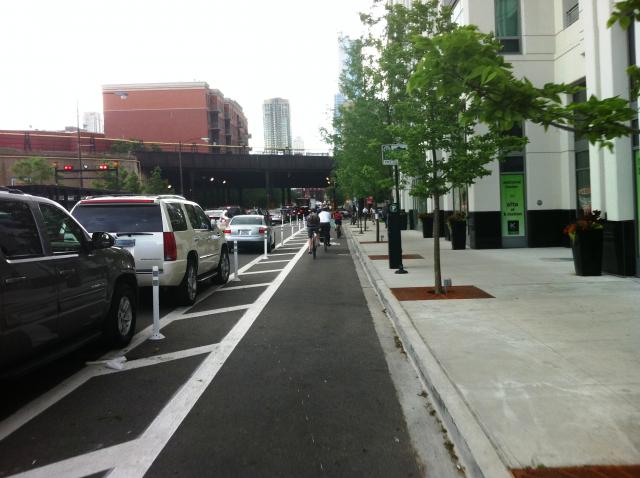
Protected Bike Lanes Mean Safer Streets in Chicago


All Chicagoans should feel safer on their city's streets—whether driving, walking or riding a bike. No matter if you're an 8-year-old child or 80-year-old grandmother, they should be able to ride a bike in the city without fearing for their safety.


Protected bike lanes are designed with all kinds of people in mind. I believe they make biking a safe and easy option for everyone. Protected bike lanes use physical barriers or buffers between people riding bikes and motorized traffic to help cyclists feel more comfortable on the street. By providing a physically separated space on the roadway for bicylists, protected lanes help reduce conflicts by encouraging predictable and responsible behavior by all street users. As a result, the street become a safer place for everyone.

Some numbers that bear repeating

  • People want safer streets: A Portland, OR study found that 60 percent of the public would be interested in biking, but do not for fear of safety.
  • Protected lanes reduce crashes: New York City's protected lane on 9th Avenue led to a 56 percent reduction in injuries to all street users and an 84 percent reduction in sidewalk riding.
  • Protected lanes increase ridership: New York City's Prospect Park West protected lane saw a 190 percent increase in weekday ridership, with 32 percent of those cyclists under age 12.

Active Trans’ Neighborhood Bikeways Campaign is working for the creation of a 100-mile network of protected bikeways that will reduce crashes and increase ridership while connecting Chicago neighborhoods.
Learn more and join the campaign.

Wednesday, September 14, 2011

Built In Bike Lock

Andrew Leinonen staylocked bike frame and lock photo

Andrew Leinonen staylocked bike frame and lock photoThere is the basic bike rule that the lighter the bike, the heavier the lock. Toronto designer Andrew Leinonen breaks the rule; in his new design, the bike is the lock. It's really clever; the lock is an integral part of the frame, and without it, the bike is unrideable.


Andrew tells Herb at iBikeTO:
Putting my mind to the endemic problem of urban bike theft, I realized that in a big city like Toronto or NYC, any lock (no matter how bulky or heavy) can only serve as a deterrent for a determined thief with the right tools. This challenge was the inspiration for the StayLocked bike, a design that integrates the lock directly into the frame. The bike's seatstays have been replaced with a U-lock on a pivoting joint. This is a 'scorched earth' approach; any thief that breaks the lock breaks the bike as well, rendering it unrideable and without value.

Andrew Leinonen staylocked bike frame and lock photoAndrew Leinonen staylocked bike frame and lock photoWhen riding the bike, the U-lock shackle is securely clamped into the rear triangle, but when the rider wants to lock up the bike, they simply unlock the shackle, swivel it into place around the post (or whatever) they are locking to, and slide on the lock body, as with a standard U-lock. Using the lock is instantly familiar, and doesn't require that riders change their behaviour or carry anything with them besides a key. It even saves weight, since you don't need to bring a heavy lock or chain with you (and a rack or bag to carry it with).
Because the U-lock replaces part of the frame, there is much less additional weight to carry around, and it eliminates the possibility of forgetting your lock. Furthermore, the bike thief doen't get anything for their work, the bike will fold up under them. Just don't ever lose your key.

Tuesday, September 13, 2011

Folding Electric Bicycle by Concious Commuter


 Conscious Commuter has come up with a bike that brings together the compactness of a folding bike, the extra oomph provided by an electric bike, and a hat-tip to the classic step-through frame.

Gabriel Wartofsky of Conscious Commuter has spent 2 years worth of nights and weekends working on come up with a design that is both functional and looks wonderful -- none of the clunkiness that so many electric bikes are burdened with, and less of the kids'-toy look that many folding bikes have.
Here's the slick video showing how the bike folds and unfolds:

From the bike's blog: "Our Prototype #001 was outfitted with a LiPo 36 volt, 10 ah battery, capable of 15-20 miles per charge. it had a 350 w motor, and a throttle assist system. We are discussing the possibility of offering an initial internal battery with the bike, with the option to outfit the bike with auxiliary external batteries for long distance hauls."

If you think this bike design is as rad as I think it is, you can check out the Kickstarter campaign through which the designer is trying to raise $25,000 to get the bike beyond prototype, taking it to the next level of design -- which will be crowdsourced!
I'm looking for crowd-sourced input on options, configurations, colors, names and styles - be part of the product design / development process! Want to be on the inside of live product design sessions? You'll have the opportunity to participate in live on-line planning meetings -- available to all $10+ backers!
The bike is not just an interesting idea, it is also a tribute to Wartofsky's mother who encouraged the family to travel by bike since the family never owned a car: "I want people to experience again the magic of the bicycle my mother lived by for most of her life. My design challenge was to design an e-bike that will enable commuters to re-acquaint themselves with the hidden magic that surrounds daily travel. An easy, fun way to get around. And I can't do it without you."

Monday, September 12, 2011

New York Times Gives Sadik-Khan a Big Thanks

thanks-bruni.jpg

The graphic says it all, as Frank Bruni writes about the wonderful job New York City Transportation Commissioner Janette Sadik-Khan has been doing for cyclists, in the face of serious opposition. Bruni writes in the Times:
If a city believes that biking is part of a better future, it must sometimes muscle through a reluctant, rocky present. That's precisely what Bloomberg and Sadik-Khan have done, in a fine example of the way the mayor's frequent imperiousness and imperviousness to criticism can work to the city's long-term advantage. If anything, the two of them should move even faster and more boldly, but that's pure fantasy, given the opposition, bordering on hysteria, they've met so far.

Bruni quotes the Chicago transportation commissioner on why bikes are such a good alternative to the car:
The Chicago transportation commissioner, Gabe Klein, noted that biking pushed back against a range of modern ills. "There's the congestion problem," he said. "The pollution problem. The obesity problem. The gas problem."
On top of all that, it makes an important statement about our priorities -- about our willingness to amend the reckless, impatient, gluttonous ways that have created not only smog and clog in our cities but also a staggering federal debt.

"Bikes are definitely a symbol of what your city stands for," said Klein.
More in the New York Times

Thursday, September 8, 2011

New York Tour de Fashion

Fashion Week is in full gear in New York City, and stylish men and women are wanting to make way through the streets of the city to see the Spring 2012 collections in anything but a cab or underground are able to tap into something a lot more fun: decorated bikes by some of the world's top designers.

The bikes, available to Fashion Week attendees free of charge, are custom-decorated by the likes of Doo-Ri Chung, Diane Von Furstenberg, Betsey Johnson, Nanette Lepore, Isaac Mizrahi, and more.

The Tour de Fashion bicycle fleet, purchased by the Fashion Center from Bowery Lane Bicycles, are handmade in New York City and will be available free of charge at tented bike stations located on the Broadway Plazas at 40th Street.

Interested in buying one of the stylish cycles? Bids started today for post-fashion week purchase. Place your bid at Charity Buzz.

Tuesday, September 6, 2011

$4 Grocery Paniers for Your Bike


One of the easiest trips that people can make by bike, is to the grocery store. With the use of reusable bags, people can typically get out of a simple grocery trip with 2 bags of stuff. Without store bought paniers, it can be difficult and dangerous to transport these groceries by bicycle. Below is a cheap and easy way to make homemade paniers to help on these short trips.

The materials are really simple:
  • 2 reusable grocery bags
  • 1/4" thick 2'x4' piece of masonite (or "hardboard" at Home Depot; same stuff used for clipboards)
  • 1 bungee cord
You can find the reusable bags at many places now, but possible places include Publix, Target, Trader Joe's, Whole Foods, Meijer, Walmart, Kroger, and Ikea. They also make insulated ones which would be great for refrigerated items.

Tip: You can get a piece of the wood deeply discounted if you look for one that's damaged.

Cut some of the wood to fit into the bags:

Staple the wood inside the bags to keep them in place.

Then cut two of the handles in the middle:

Sew the bags together:

Then, throw them over your bike rack!

Use a bungee to keep them in place, and voila! You have lightweight panniers that fold down flat and that you can take into the store with you!

Sure beats paying $50+ for ones from the bike shop. You could probably make them even stronger by double-bagging, since by now all of us probably have about 12 of these give-away canvas bags piled up in our closets.
Transportation for America Coalition