Monday, September 12, 2011

New York Times Gives Sadik-Khan a Big Thanks

thanks-bruni.jpg

The graphic says it all, as Frank Bruni writes about the wonderful job New York City Transportation Commissioner Janette Sadik-Khan has been doing for cyclists, in the face of serious opposition. Bruni writes in the Times:
If a city believes that biking is part of a better future, it must sometimes muscle through a reluctant, rocky present. That's precisely what Bloomberg and Sadik-Khan have done, in a fine example of the way the mayor's frequent imperiousness and imperviousness to criticism can work to the city's long-term advantage. If anything, the two of them should move even faster and more boldly, but that's pure fantasy, given the opposition, bordering on hysteria, they've met so far.

Bruni quotes the Chicago transportation commissioner on why bikes are such a good alternative to the car:
The Chicago transportation commissioner, Gabe Klein, noted that biking pushed back against a range of modern ills. "There's the congestion problem," he said. "The pollution problem. The obesity problem. The gas problem."
On top of all that, it makes an important statement about our priorities -- about our willingness to amend the reckless, impatient, gluttonous ways that have created not only smog and clog in our cities but also a staggering federal debt.

"Bikes are definitely a symbol of what your city stands for," said Klein.
More in the New York Times

Thursday, September 8, 2011

New York Tour de Fashion

Fashion Week is in full gear in New York City, and stylish men and women are wanting to make way through the streets of the city to see the Spring 2012 collections in anything but a cab or underground are able to tap into something a lot more fun: decorated bikes by some of the world's top designers.

The bikes, available to Fashion Week attendees free of charge, are custom-decorated by the likes of Doo-Ri Chung, Diane Von Furstenberg, Betsey Johnson, Nanette Lepore, Isaac Mizrahi, and more.

The Tour de Fashion bicycle fleet, purchased by the Fashion Center from Bowery Lane Bicycles, are handmade in New York City and will be available free of charge at tented bike stations located on the Broadway Plazas at 40th Street.

Interested in buying one of the stylish cycles? Bids started today for post-fashion week purchase. Place your bid at Charity Buzz.

Tuesday, September 6, 2011

$4 Grocery Paniers for Your Bike


One of the easiest trips that people can make by bike, is to the grocery store. With the use of reusable bags, people can typically get out of a simple grocery trip with 2 bags of stuff. Without store bought paniers, it can be difficult and dangerous to transport these groceries by bicycle. Below is a cheap and easy way to make homemade paniers to help on these short trips.

The materials are really simple:
  • 2 reusable grocery bags
  • 1/4" thick 2'x4' piece of masonite (or "hardboard" at Home Depot; same stuff used for clipboards)
  • 1 bungee cord
You can find the reusable bags at many places now, but possible places include Publix, Target, Trader Joe's, Whole Foods, Meijer, Walmart, Kroger, and Ikea. They also make insulated ones which would be great for refrigerated items.

Tip: You can get a piece of the wood deeply discounted if you look for one that's damaged.

Cut some of the wood to fit into the bags:

Staple the wood inside the bags to keep them in place.

Then cut two of the handles in the middle:

Sew the bags together:

Then, throw them over your bike rack!

Use a bungee to keep them in place, and voila! You have lightweight panniers that fold down flat and that you can take into the store with you!

Sure beats paying $50+ for ones from the bike shop. You could probably make them even stronger by double-bagging, since by now all of us probably have about 12 of these give-away canvas bags piled up in our closets.

Wednesday, August 31, 2011

Bike Sharing Tour de World

boris paris photo
London's Boris bikes are being invited to all the best places. They went to Paris for an outing and they have been invited to Toronto, Ottawa and Montreal as well. Lucky them.


louvre boris photoTwo enthusiastic Brits took their Boris bikes to Paris for the day on the Eurostar train. Sure, it would have been cheaper and easier to just pick up a Velib when they arrived, but c'est la vie. Les Boris Bikes went everywhere: the Louvre, the Eiffel Tower, the Musee d'Orsay and the streets and bridges of the magic city. They did receive some curious looks: a couple of Londoners on Parisian hire bikes cycled over to find out what on earth they were up to with Boris Bikes in Paris. And it was sore to cycle on the cobbled side streets.


As for a comparison between London and Parisian bicycles :
"My first thoughts are that Vélib bikes look a lot less conspicuous than the big heavy blue London bikes, and thus are less noticeable in the streets which might be a good or bad thing depending on your point of view. They also come with padlocks, which seems a bit superfluous as Vélib bike stands are as plentiful as Boris Bike stands are in London. They do however have the advantage of a larger front basket, which it would be nice to have in London, as the small "rack" on the Boris Bikes is a bit restricting."

many bikes photoBixi bikes from Montreal, Melbourne, London, Washington DC / Arlington, Minneapolis and Ottawa / Gatineau are visiting Toronto for the month: bienvenue. Although there are only two of each, cyclists will get a chance to try out this international selection, if they can find them.

bikes bixi photoThey are all painted different colours: London is blue, Ottawa is red and white and Montreal is grey. There are local differences as well. The Minneapolis and Washington bikes have a half-basket. The seats on the Montreal bikes don't go as high as the Toronto ones. The brakes on the London bikes had to be switched because they are on opposite handles from the North American configuration.

Sunday, August 28, 2011

Biking Your Kids to School

Regionally here in Orlando, 15 percent of rush hour traffic is attributable to parents driving their kids to school. In 2001, only 16 percent of kids biked or walked to school as opposed to 42 percent in 1969, according to statistics from the Centers for Disease Control and Prevention.

School is starting again and with it comes the question of how to get your children back and forth to school. Walking or biking to school has numerous benefits for your child and your family and can even help cut down on school traffic. With school starting back up, it is a prime time to direct focus on making routes to schools safer for children biking and walking to school. It also is time to train children how to properly ride a bicycle and what the rules of the road are.

Why shouldn’t you just drive them?
I’m sure you’re thinking that it is just so much easier to just hop in the car but there are a lot of benefits to having your kids bike or walk to school:
  • It’s healthier. Your son or daughter will now have two short periods of physical activity each school day for a total of 10 separate times. Your child will be less likely to be overweight and less likely to become sick. “Over the past 30 years the percent of overweight children aged 6 to 11 years has more than doubled,” according to the Centers for Disease Control and Prevention.
  • Burning energy. Burning off a little energy in the morning will allow her to better concentrate at school. Burning off a little energy in the afternoon will mean he is less likely to be bouncing off the walls when he gets home.
  • Saving money. Gas is insanely expensive. Additionally, the first five miles of a car trip are when a car’s engine is the least fuel efficient.
  • Saving time. Obviously, a car is faster than a bike, right? Most schools now have a drop off procedure that involves your car sitting in a line with the other cars and waiting to drop them off. By going by bike, I bypassed this at my son’s preschool. His friend’s father commented to me several times that he would be sitting in his car, watch me ride up, drop Christopher off and leave while he had not moved. Additionally, trying to get my son strapped into a car seat is a battle. He will more willingly hop onto the bike.
Other perks include that your kids will get a sense of direction and you’re more connected to your community. We say “good morning” to those we pass along the way to school such as the gentleman we see walking his dog most mornings, check out flowers, learn where his friends live, etc.

Okay, I’m convinced. Now what?
Planning a route will take the most time. The route you drive is not likely to be the same route you’ll ride. Use low-traffic residential streets. For children younger than 9-years-old, use sidewalks, side paths or bike paths. People are not accustomed to look for bicyclists and pedestrians on sidewalks, however, so you will have to watch out for cars backing out of drive ways without noticing you. Intersections where there are stop signs, traffic signals or crossing guards are preferred.

Once you have a route, practice it on a weekend or other day there is no school. Bring a snack. Ride there, play on the playground equipment and eat a snack and then ride home. Is the route safe? Can your child ride the whole distance? Maybe a tag-a-long hooked up to your bike will be a better option.

Don’t forget
You and your child will both need helmets and will need to make sure you are wearing the helmets correctly.
You’ll need a lock for your child’s bike. A combination lock might be best unless you have a spare key.

When the weather turns colder
If your son or daughter is pedaling, they will be generating heat and may not need as heavy of a coat. However, since riding is faster than walking, a wind resistant outer layer is best.

Some precautions
Since children are shorter, it is harder for them to see over cars, etc. and it is also harder for drivers to see them. They often cannot judge the speed of cars and may think that the driver will “look out for them” the same way a parent would.  Teach them to look left, right, and then left again before crossing the street and to only cross at intersections.

Do I have to ride with them?
Until about nine- or ten-years-old, most children will still need an adult to help them cross the street. Your school may already have a “walking school bus”  or “bike train” or you can work with your school to start one.

For more tips on bike safety for children, visit the League of Illinois Bicyclists’ Kids Safety Information page.

Thursday, August 25, 2011

Bike Lanes Are Good For Everyone

bikelane blocked new york photo
Listening to the noise from some politicians in New York and Toronto, you would think that bike lanes are the worst things that ever happened to their roads, taking up space that was theirs and theirs alone. But Planners Ken Greenberg and Trent Lethco suggest otherwise; they actually claim that if drivers want more space on the roads, they should push for more bike lanes. It's like that old Kirk cartoon where the drivers stuck in traffic are all saying "If these idiots would just take the bus, I could be home by now."- the more people who use alternative modes of transport, the more room there is on the road for drivers. They write in the Globe and Mail:
Every additional trip we take on foot, on a bicycle or by public transit frees up significant space for drivers, since the "footprints" of these other modes are so much smaller. The cyclist beside you is not the car in front of you; the bicycle locked to a ring at curbside means one less parking space is taken. Driver, cyclist and pedestrian are complementary rather than mutually exclusive categories. Most of us are all of these at different times. What's crucial is the proportion of time we use each mode, and creating communities where the car is needed for only certain types of trips. For other trips, we can make more efficient choices.
It really makes perfect sense. I used to drive and now I cycle; that's one less car on the road, one less parking space being filled.
By promoting alternatives and making safe and comfortable space for cyclists (and pedestrians) in shared rights of way, we make room for driving when it's needed. By trying to make it easier for drivers by "hogging" the right of way, we make it impossible.

Tuesday, August 23, 2011

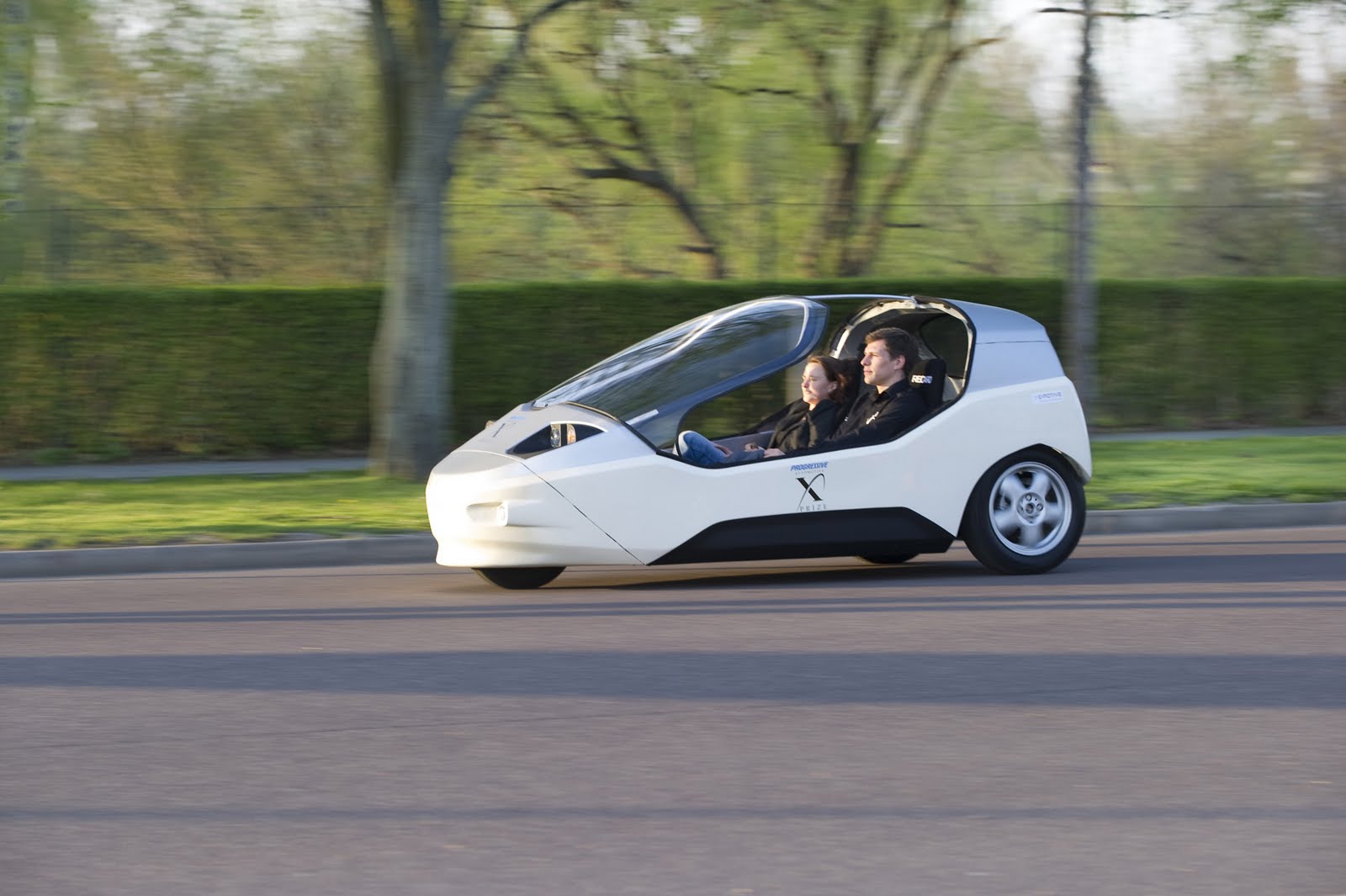
TWIKE - A Pedel/Electric Hybrid


Have you ever seen or heard of a TWIKE? They were invented in 1986, but are mainly rolling around in Germany, Switzerland, and the Netherlands. They may not be new to you, but I hadn't seen any of these until a friend sent me a link to them. This is a perfect response to people when they complain about not riding a bike because of weather conditions or being worried about their appearance when they are commuting.

The TWIKE is an electric vehicle that is designed to carry two passengers and cargo. It can be driven in electric-only mode or electric + pedal power mode (pedaling extends the range of the vehicle but does not substantially add to the vehicle's top speed). The top speed of the TWIKE is 50-60 mph, and is steered with a joystick. The TWIKE is efficient, environmentally friendly, attractive and sportive.

The TWIKE isn't too cheap. The US price tag is $20K-$30K, but you can get several bells and whistles that make the TWIKE just as comfortable and stylish as any US car. There are only 25 in the states today, but since they are licensed as a motorcycle vehicle, they should increase in numbers as gas prices rise and people look for alternative ways to travel.
Transportation for America Coalition